Some ingredients just don’t get the credit they deserve.
Infused ghee is one of them. It’s been sitting in grocery stores and ethnic markets for years, tucked next to the butter, usually a little more expensive, often passed over in favour of something more familiar. If you’ve walked by it a hundred times without picking it up, this episode is the push you needed.
Note: I covered this topic in a newer episode on how to make cannabis infused ghee. I also go more into what makes ghee such a fabulous fat for infusions. See the updated post here.
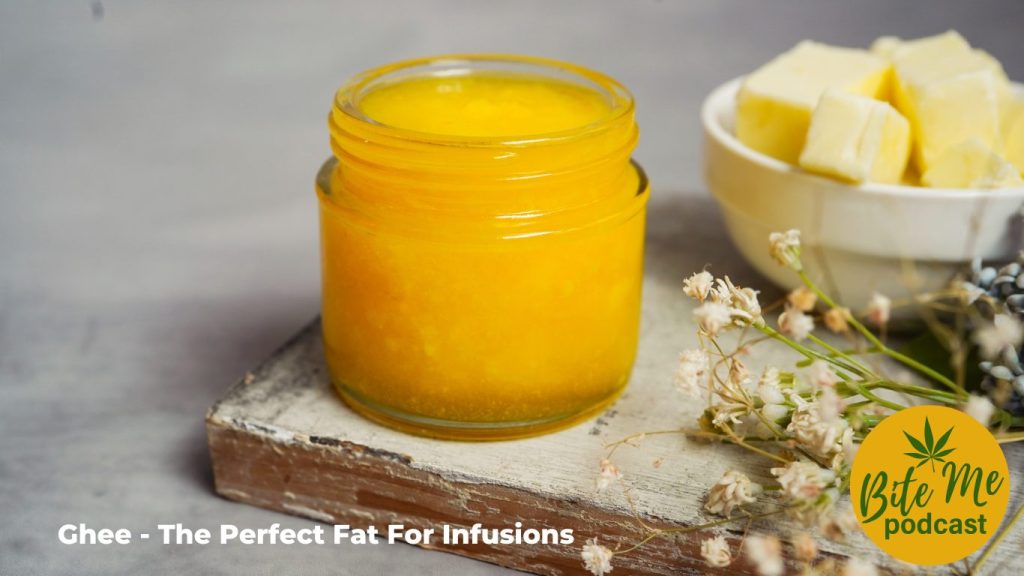
What Makes Infused Ghee Worth Your Attention
Ghee is clarified butter that has been simmered and strained to remove all the water and milk solids. What’s left behind is pure butterfat, and that matters a lot for infusions.
THC is fat soluble. Cannabinoids want to bind to fat, so more fat means a more efficient extraction. Ghee is nearly all fat. It also has a higher smoke point than butter (around 480°F compared to butter’s 350°F), a rich nutty flavour from the slight browning of the milk solids during clarification, and because the water has been removed, it’s shelf stable. No refrigeration required. Months on the shelf, longer in the fridge.
It’s also lactose-free. The clarification process removes the casein and lactose, which makes it a solid option for anyone with dairy sensitivities who still wants that rich buttery mouthfeel in their edibles.
Should You Make It or Buy It?
You can buy ghee at most grocery stores. Ethnic grocery stores tend to carry it too, and it shouldn’t be hard to find. What you will notice is the price. Good quality ghee isn’t cheap, especially if you’re looking for 100% grass-fed, non-GMO, organic. That classification matters because toxins can concentrate in animal fat, and starting with quality fat means a cleaner infusion.
The good news: you can make your own ghee at home from good quality butter, which sometimes works out better on both quality and cost. You’re essentially just gently boiling off the water and milk solids on the stove, which is a fascinating little process to watch. I’ve done it several times. Not difficult, just a bit of time.
How To Make Infused Ghee: Two Methods
On the stove: The same method you’d use for olive oil, butter, or coconut oil. Fill a pot with water and set a jar containing your ghee and decarbed cannabis inside. Let it simmer for a couple of hours, remove carefully, cool slightly, strain through cheesecloth, and store in an airtight glass jar.
In the Ardent: This is the method I used for this episode and the process is remarkably simple. Decarb in the device, then use the infusion sleeve (silicone, fits snugly inside the canister) to add your decarbed cannabis and ghee in whatever ratio you’re working with. Press a couple buttons. Come back when it’s done, pull out the sleeve, strain it. Cleanup is much easier than infusing on the stove because you’re cleaning the sleeve, not the inside of the device. It’s worth having for that reason alone.
The Infusion Rate Numbers On Infused Ghee
Ardent published lab results testing the infusion rate of ghee in their device, and the results were notable. Starting with decarbed herb at 16.26% THC, meaning 162 milligrams total, they got 147.7 milligrams into the ghee. That works out to roughly a 90% infusion rate.
For reference, some loss is always expected in any infusion. A 90% rate is high. I’ll link to that article in the resources below so you can see the full breakdown.
What to Do With Your Infused Ghee
Once you’ve got a jar of it ready: bake with it (swap one-for-one for butter in cookies, cakes, brownies), saute with it (eggs, vegetables, meats), roast with it (root vegetables especially, the nutty flavour is perfect for carrots and potatoes in the fall), drizzle it over popcorn, stir it into oatmeal or a warm beverage.
One note on cooking temperature: ghee handles heat well on its own, but THC starts to degrade around 250°F. If you’re cooking at higher temperatures, use a blend of infused and non-infused ghee, or reserve the infused version for drizzling and finishing rather than high-heat cooking.
Always calculate your dose before you use it, and label the jar when you store it. The Bite Me Dosage Calculator will help you work out the numbers.
And start low and go slow. Always.
That’s it for this week friends. Please reach to me, I love hearing from listeners! Direct messages to stayhigh@bitemepodcast.com, or leave a voice message on the podcast hotline.
Support the show by subscribing, sharing, leaving a review or buying me a cookie! Whatever way you choose, I’m grateful that you’re listening.
Stay high,
Margaret

[…] Infused Ghee […]