Making Edibles For Someone Else
Someone you love is going through it right now. They’re sick, or exhausted, or in pain, or just completely out of bandwidth for anything involving a stove. And you know how to make edibles. You want to help.
That’s what this episode is about.
I’ve been sitting with this one for a while. It started with conversations in my own life, got clearer after my interview with Jay Jay O’Brien last week about cannabis, cancer, and education, and took on a little more weight after my own father’s diagnosis earlier this year. Jay Jay got a cancer diagnosis in 2019, was given up to a year to live, and is still here. She wrote a book about it. If you haven’t listened to that episode yet, go back and do it. She knows things about using cannabis as medicine that are worth your time.
But today isn’t about cancer specifically. It’s about a question I get asked in different forms all the time. It sounds like: “I want to make edibles for my mom, but she’s never used cannabis. Where do I start?” Or: “My partner can’t cook right now. How do I make something that will actually help them?” Or: “My friend has chronic pain and she’s intimidated. She asked me to make something.”
All of those questions are the same question. And that’s what we’re talking about today.
Listen to this episode:
The Bigger Picture First
Mutual aid has been having a cultural revival, but the idea itself is old. Communities taking care of each other, not waiting for institutions to do it. Sharing resources because that’s how people survive.
Cannabis fits into that tradition in a way I find compelling. For most of its history in North America, people were growing it, making it, sharing it, taking care of each other outside of any official permission structure. Think of everyone you knew growing long before legalization. Think of every time you’ve been gifted something, or given something you made, to someone who needed it. Your kitchen is a continuation of that.
When you make an edible for someone who is sick or in pain or just can’t manage a hot stove right now, you’re participating in something that has always been about community care. That’s worth naming, because it adds some stakes to getting it right.
When you make edibles for yourself, you can experiment. If you eat too much, you spend the afternoon on the couch and you’ve learned something. When you’re making for someone else, you need to be more careful. Not because cannabis is dangerous, but because you owe it to that person to actually help them, not harm them.
Have the Conversation First
Before you turn on your oven or fire up your infusion device, you need to talk to the person you’re making for. This part is not optional. Here are the questions that matter:
Have they used cannabis before? This changes everything. Someone who has never used cannabis has no tolerance and no frame of reference for what too much feels like. You’re starting from the very beginning.
Are they cannabis curious, or cannabis convinced? There’s a difference between someone who has heard it might help and someone who has done their research and is ready. The curious person needs a very low, very gentle first experience. The convinced person still needs to start low, but the conversation feels different.
What are they hoping to get from it? Sleep support, pain relief, nausea, appetite. The answer shapes what you make and how you dose it. Someone who wants help sleeping can tolerate something that makes them drowsy. Someone managing pain while trying to function during the day needs a different approach.
What’s their relationship with food? This one gets skipped a lot. Nausea, chemo, certain medications, digestive issues all affect what form the edible should take. A rich brownie is not the right first edible for someone whose stomach has been through it. A lightly infused honey stirred into tea might be a much better entry point. Dietary restrictions matter here too.
What medications are they on? Cannabis interacts with certain medications, particularly blood thinners and some chemotherapy drugs. I am not a doctor, and this is not medical advice, but this question is worth raising with them and their care team before they start. It’s worth knowing that medications flagged to avoid with grapefruit often interact similarly with CBD. This is a gentle way to invite them to loop in their medical providers about their interest in cannabis.
Dosing for Someone Else
I talk about dosing on the show a lot. Start low, go slow, find your minimum effective dose. Use the Bite Me Dosage Calculator before you make your first batch.
When you’re dosing for someone else, especially someone new to cannabis, I add one more rule: go lower than you think you need to.
You know your body. You have some frame of reference for how edibles affect you. The person you’re making for has none of that. For a true cannabis beginner, I would start at 2 milligrams per serving. Five milligrams if they have some experience. That sounds very low to anyone who’s been making edibles for a while. But a bad first experience can put someone off cannabis for years. I have talked to so many people who tried an edible once, had too much, and swore they would never do it again. That’s a real shame, especially when the person might truly benefit from what the plant can offer.
A 2-milligram experience that does something gentle and positive is worth ten times more than a 20-milligram experience that sends them to bed for eight hours wondering if they’re dying.
A Note on THCA
This came up in my conversation with Jay Jay, and I think it’s underused in mutual aid situations.
THCA is the raw, unheated form of THC. It’s what’s in the plant before you decarb it. Because it hasn’t been decarboxylated, it doesn’t cause intoxication. But it is not without benefit. THCA is a potent anti-inflammatory, anti-nausea, and analgesic. It’s appetite stimulating and neuroprotective.
For someone who cannot or will not get high, but who might benefit from what the plant offers, THCA is worth exploring. The simplest way to access it is cannabis tea made from dried, non-decarbed flower, or infusing dried cured cannabis into an oil at a temperature low enough that decarboxylation doesn’t occur. Jay Jay made an important point about this: the flower needs to be dried and cured first, not fresh from the plant, or you end up with a mess.
If you’re making something for someone who is immunocompromised or dealing with a serious illness, please listen to the Jay Jay O’Brien episode. There’s a lot in there that will help you think more comprehensively about this.
What to Actually Make
Here are five preparations I keep coming back to for mutual aid situations. Each one has something specific going for it.
1. Infused Overnight Oats
I have a recipe for this on the site, and I keep returning to it for situations exactly like this. It checks every box: make-ahead, easy to portion, gentle on digestion, requires no cooking skill to eat or to make. You infuse it with a measured dose of cannabis-infused coconut oil, nut butter, or whatever works for their dietary needs. You calculate the dose per serving. You can make a batch and leave it in someone’s fridge without them having to do anything.
Use the Bite Me Dosage Calculator to do the math before you make your batch.
2. Infused Golden Milk
Turmeric, ginger, coconut milk, a little honey, black pepper to activate the turmeric, and your measured infused coconut oil. Warm, anti-inflammatory, easy to consume even when you’re not feeling great. The dry ingredients are shelf stable, so you can leave someone a little kit with a note on how to make it. For someone dealing with inflammation, pain, or nausea, this combination is genuinely thoughtful. The turmeric and ginger are doing real work alongside the cannabis.
3. Infused Chicken Soup or Bone Broth
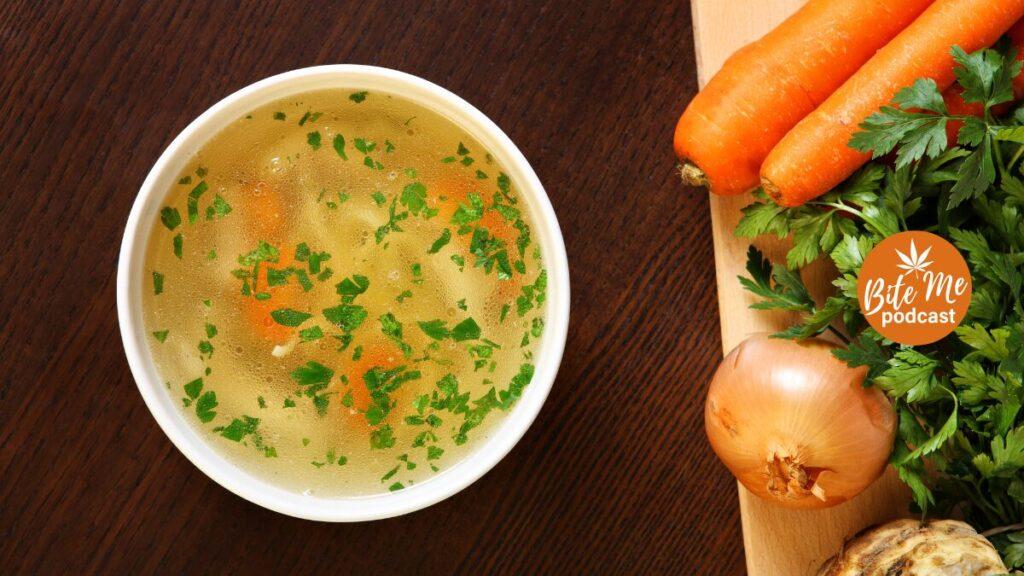
Could we do an episode on mutual care without talking about this? Probably not. Make your soup exactly as you normally would. At the very end, off heat, stir in your measured infused olive oil per serving. The reason you add it at the end is that prolonged high heat degrades cannabinoids. You want the oil in at eating temperature, not simmered for two hours. Portion it out, label it carefully. A thermos of infused chicken soup left on someone’s doorstep is one of the most loving things you can make in your kitchen. I mean that.
4. Infused Herbal Honey
Cannabis-infused honey has a long shelf life, which makes it one of the most practical mutual aid preparations I can think of. It goes in tea, on toast, stirred into yogurt, drizzled over oatmeal. The person can incorporate it into whatever they’re already eating without needing to do anything special. Because you’re mixing infused fat into honey (cannabinoids are fat soluble, and honey has no fat on its own), warming the honey slightly helps the two mix together. If you know how potent your infused oil is before you mix it in, you’ll have a solid approximation of the dose per teaspoon. Label it with that number and leave it with instructions.
I did a whole episode on infusing liquid sweeteners a while back. The process is the same whether you’re using honey, maple syrup, or agave.
5. Cannabis Suppositories
I know. Stick with me.
Jay Jay and I talked about this in our interview, and she was clear that close to 100% of the people she works with in cancer care use suppositories. The reason is bioavailability. Suppositories bypass the liver, which means significantly more cannabinoids get into the body without the intense, long-lasting high that comes from edibles going through first-pass metabolism. If you’re making for someone who needs higher doses of cannabinoids without spending their days sedated, this is worth knowing about.
You make them with FECO (full extract cannabis oil) and a carrier like cacao butter, poured into molds. Easier than people think. Jay Jay’s exact words: “If you can melt something, you can make a suppository.”
These can be used rectally and, for women, vaginally. Mutual aid in the kitchen isn’t always cookies. Sometimes it’s the most effective delivery method available, made by someone who loves you at home, because the commercial version doesn’t exist at the dose you need or the price you can afford.
Honorable mention: topicals. I use them every day. Cannabis topicals are a gentle, no-high entry point for someone dealing with arthritic pain, joint pain, or physical discomfort of most kinds. They don’t require any conversation about getting high, and they’re easy to incorporate into an existing routine.
Before You Drop It Off
A few practical things, most of which you’ve heard from me before. They still bear repeating.
Label everything. Every single edible you make for someone else needs to be clearly labeled: approximate dose per serving, date made, ingredients, whether it contains cannabis, and how to store it. Write it down and put it on the container. Don’t assume they’ll remember what you told them. My own father accidentally ate something from my freezer a couple of months ago. It was labeled. He didn’t read it carefully enough. My 94-year-old dad got very, very high for the first time in his life. We laugh about it now. It was fine because I was there. But the point stands. Label it so clearly that someone who doesn’t understand what they’re looking at will still get the message.
Send them the calculator. The Bite Me Dosage Calculator is free. Walk them through it if you need to. Knowledge is harm reduction.
One serving. Wait two hours. That instruction goes with every edible you hand to a beginner. One serving, then wait a full two hours before deciding whether to have more. The most common mistake with cannabis edibles is taking more before the first dose has had a chance to do anything. For extra caution, suggest they start with one serving and if nothing happens, try again the next day. Two hours is the floor, not the ceiling.
Check in. Don’t drop off the food and disappear. Follow up. How did it go? How did they feel? Did it help? This isn’t just good caregiving. It’s how you improve your dosing for the next batch.
Know your limits. You’re not a pharmacist. You’re not a clinician. If the person you’re making for is on a complex medication regimen, dealing with a serious illness, or asking questions you can’t answer, encourage them to connect with someone who can help. Jay Jay’s organization, EducaNation, is a great resource. So is the Realm of Caring, a cannabis-focused nonprofit I had the chance to interview earlier this year. They serve people not just in the United States but in the UK, Canada, Australia, and beyond.
I also have a guide called Cannabis Edibles for Wellness: Science, Formulation, and Protocols that covers a lot of ground between home edibles making and therapeutic use. If you’re navigating serious illness, that’s a good place to dig deeper.
Your Kitchen Is Already Capable of This
We talk a lot on this show about taking control of your high life, making your own medicine, being self-reliant. All of that matters. But the flip side of self-reliance is community reliance. The reason self-reliance matters is that you have something to give. So when the person next to you can’t do it for themselves, you can step in.
That’s mutual aid. That’s what your kitchen is capable of.
The fact that you can grow a plant, decarb it in your oven, and produce something that reduces someone’s pain, helps them sleep, or just helps them get through a rough week? That’s not a small thing. It’s one of the most extraordinary things a home cook can do.
Sometimes the person who needs this is someone dealing with illness. Sometimes it’s an overwhelmed parent. Sometimes it’s a friend going through a big life change. The reason doesn’t have to be dramatic. The care just has to be there.
Resources Mentioned in This Episode
- Bite Me Dosage Calculator (free)
- Bite Me Dose Diary
- Cannabis Edibles for Wellness: Science, Formulation, and Protocols (guide)
- Jay Jay O’Brien, High Hopes for Healing
- Realm of Caring (cannabis-focused nonprofit, international)
- Cannabis Infusions Complete Guide
- Coming up: Robin Swan on DIY edibles as an act of rebellion
Track Your Batches
Every time you make a new batch with infused ingredients, the variables change. Different flower, different potency, different ratios. Writing it down means you build a reference you can actually use. The Bite Me Dose Diary is built exactly for this.
That’s it for this week friends. Please reach to me, I love hearing from listeners! Direct messages to stayhigh@bitemepodcast.com, or leave a voice message on the podcast hotline.
Support the show by subscribing, sharing, leaving a review or buying me a cookie! Whatever way you choose, I’m grateful that you’re listening.
Stay high,
Margaret
FAQ For Making Edibles For Someone Else
How do I know how much cannabis to put in something I’m making for a beginner? Start at 2 milligrams per serving. That sounds very low if you’ve been making edibles for a while, but it’s the right starting point for someone with no tolerance and no frame of reference. Use the Bite Me Dosage Calculator to calculate the dose per serving before you make your first batch. A gentle first experience is worth far more than an overwhelming one.
What’s the best edible to make for someone dealing with nausea or digestive issues? Skip anything rich or heavy. A lightly infused honey stirred into herbal tea, or a golden milk made with turmeric, ginger, coconut milk, and a small amount of infused coconut oil, are both easy on the stomach and anti-inflammatory. Overnight oats are another good option because they’re gentle and easy to portion.
What if the person can’t or won’t get high? THCA is worth exploring. It’s the raw, unheated form of THC, which means it doesn’t cause intoxication, but it does have anti-inflammatory, anti-nausea, and analgesic properties. You can access it through cannabis tea made from dried non-decarbed flower, or through an oil infused at a temperature low enough that decarboxylation doesn’t occur. Cannabis topicals are another option: they don’t enter the bloodstream and don’t produce a high.
Can I make edibles for someone who is on medication? Raise the question with them and their care team before they start. Cannabis interacts with certain medications, particularly blood thinners and some chemotherapy drugs. Medications flagged to avoid with grapefruit often interact similarly with CBD. This is not medical advice, but it’s a conversation worth having.
What’s the most important thing I can do after I give someone an edible? Label it clearly, walk them through the dosage, give them the instruction to take one serving and wait two full hours before deciding whether to have more, and then follow up. Check in. Find out how it went. That information helps you make a better batch next time, and it’s also just good caregiving.
What if I’m not sure my homegrown cannabis is potent enough to dose accurately? If you can’t test your input material, you’re approximating. The conservative approach: if you estimate the edible is around 10 milligrams per serving, suggest your recipient start with a quarter or half serving. Working from a conservative estimate protects them if your material turns out to be stronger than expected.
Timestamps For Making Edibles For Someone Else Audio
Making Edibles for Others (00:00:06)
Introducing the concept of making edibles for people who can’t, framing it as mutual aid in the kitchen.
The “Why” Behind This Episode (00:01:11)
Discussing the common questions received about making edibles for others, often for medical reasons or due to intimidation.
Mutual Aid and Cannabis Community (00:02:08)
Exploring the history of mutual aid and how the cannabis community has always practiced community care through sharing.
Important Considerations Before You Start (00:04:24)
Highlighting the crucial conversation to have with the recipient, covering their cannabis experience, goals, and medical history.
Medication Interactions (00:06:30)
Warning about potential interactions between cannabis and certain medications, like blood thinners, and the importance of consulting medical professionals.
Dosing for Beginners (00:07:43)
Emphasizing the “start low, go slow” rule, recommending a very low dose like two milligrams for a true beginner.
The Benefits of THCa (00:09:59)
Discussing THCa, the raw form of THC, as a non-intoxicating option with anti-inflammatory and anti-nausea benefits.
Practical Edible Ideas (00:11:09)
Introducing several easy and gentle edible ideas suitable for people who are sick or have digestive issues.
Infused Overnight Oats (00:11:28)
A make-ahead, easy-to-portion, and gentle option for a consistently dosed edible that requires no cooking to eat.
Infused Golden Milk (00:12:08)
A warm, anti-inflammatory drink combining turmeric, ginger, and cannabis-infused oil, which is comforting and easy to consume.
Infused Chicken Soup or Bone Broth (00:12:48)
A classic comfort food, infused by adding cannabis oil at the end to preserve cannabinoids, a universal act of care.
Infused Herbal Honey (00:13:42)
A versatile and long-lasting option that can be easily added to tea, toast, or yogurt for simple dosing.
Cannabis Suppositories (00:14:32)
Explaining the benefits of suppositories for high bioavailability without intoxication, ideal for those needing higher doses for medical reasons.
Topicals as an Alternative (00:16:30)
Mentioning topicals as a safe, non-intoxicating entry point for managing localized pain like arthritis or joint pain.
Labeling and Safe Consumption Practices (00:17:08)
Stressing the importance of clearly labeling every edible with dose, date, and ingredients to ensure safety.
The Two-Hour Rule (00:18:20)
Advising beginners to wait at least two hours after one serving before consuming more to avoid overconsumption.
Follow-Up and Dosing Adjustments (00:19:37)
The importance of checking in with the person to see how the edible affected them and to improve future dosing.
Know Your Limits as a Maker (00:20:28)
Advising makers to encourage recipients with serious medical conditions to connect with professional resources for guidance and support.
Community Reliance and Giving Back (00:21:54)
Concluding with the idea that self-reliance enables community reliance, empowering you to care for others in need.
Upcoming Episodes (00:22:59)
A preview of future episodes, including a conversation on DIY edibles as rebellion and another on summer beverages.
Speaker: 00:07
Welcome friends to episode 355. Today we're talking about making edibles for someone who can't. Mutual aid in the kitchen. I'm your host, Margaret, a certified gangier, a TCI certified cannabis educator, and I believe your kitchen is the best dispensary that you'll ever have. And this is Bite Me, the show about edibles. And today's episode is one that I've been thinking about or ruminating a little bit for a while now. And it started with some conversations that I've had recently and some things that have been happening in my personal life. And it obviously got clearer when I published my interview with JJ O'Brien last week about cannabis cancer and education. And if you haven't had the chance to listen to that yet, please go back and do that. JJ got a cancer diagnosis in 2019 and was given up to a year to live. And she's still here and she wrote a book about it. And she knows about using cannabis as medicine. And you'll learn a whole lot from her in that conversation. That conversation kind of changed some things for me. One of the reasons I had that conversation to begin with was because of my own father's cancer diagnosis earlier this year. But today isn't about cancer specifically. It's about a question that I get asked often in other forms. And it goes something like this, depending on the situation. But I want to make edibles for my mom, but she's never used cannabis before and I don't know where to start or my partner is going through a pretty big medical issue and they can't cook right now. How do I make something that will actually help them? Or my friend has chronic pain and she's interested in trying edibles, but she's intimidated and she asked me to make something for her because she knows I love edibles. What do I do? That question in all its forms, it's all its iterations, is what this episode is about making edibles for someone who can't make them for themselves or doesn't have the know-how or to make them for themselves. Even though, as we all know, it doesn't take much to learn, but that intimidation factor can really prevent people from trying it out themselves. And especially if they have some health issues going on, they may not have the capacity, the energy, the ability to do that right now. Mutual aid in the kitchen. The most practical, loving thing you can do with a pound of butter and a bag of weed. So let me start with something a little bit bigger before we get into the more practical stuff. Mutual aid has been having a cultural moment, even though the idea is old. And what is mutual aid? But communities taking care of each other and not waiting for institutions to do it, for governments, for corporations. And they're sharing resources because that's how people survive. Community. And cannabis fits into that tradition in a way that I find really compelling. For most of its history in North America, in particular, because that's the context,
Speaker: 03:09
the knowledge that I have, people have been growing, making it, sharing it. We're doing exactly that, taking care of each other outside of any official permission structure, even though it wasn't necessarily legal to do so. Think of all the people that you knew that were growing long before legalization. If you live in a place where it's legal, think of all the times where perhaps you've been gifted something, or you yourself have gifted something that you've grown lovingly in your backyard or in a tent, or when you've made edibles and shared it with others, or topicals. Your kitchen is a continuation of that. When you make an edible for someone who is sick or in pain or just can't manage a hot stove right now, you're participating in something that has always been about community care. And I think that's worth talking about. And it's also worth naming because it adds some stakes to getting it right. When you make edibles for yourself, you can experiment without too much issue. If you eat too much, you spend your afternoon on the couch and you've learned something. But when you're making it for someone else, you need to be more careful. And I think that goes without saying, but not because cannabis is dangerous, but because you owe it to the person that you're caring for to actually help them and not harm them. So let's talk about how to do that well. And on another note, if you're interested, over the last little while, I picked up a couple of small books from my local bookstore. One is called Mutual Aid: Building Solidarity During This Crisis and the Next by Dean Spade and The Care Manifesto, The Politics of Interdependence. And these are both really great books on the topic of mutual aid. If there's one thing that I've taken away from these, it's that community is everything. So before you even turn on your oven or fire up an infusion device, you need to have the conversation with the person you're making these edibles for. And this is a part you don't want to skip. It's obviously the most important one. And here are some of the questions that you probably need to have answered. Have they used cannabis before? This changes everything about where you start for obvious reasons. Someone who's never used cannabis has no tolerance, no frame of reference for what too much feels like. And you're starting them at the very beginning. Are they cannabis curious or cannabis convinced? There's a difference between someone who has
Speaker: 05:32
heard cannabis might help them and someone who's done their research and is ready to commit. The curious person needs a very low, very gentle first experience. The convinced person still needs to start low, but the conversation is going to feel different because they have that understanding, they've answered some of these questions for themselves. What are they hoping to get from it? Sleep support, pain relief, nausea relief, appetite. The answer shapes what you make and how you dose it. Someone who wants help sleeping is going to be fine with something that makes them a little drowsy, whereas someone who needs to get through the workday while managing pain is going to need a different approach. What's their relationship with food? This one gets overlooked. Nausea, chemo, certain medications, digestive issues, all of these affect what form the edible will take. A rich, heavy brownie is not the right first edible for someone whose stomach has been through it. A lightly infused honey in their tea might be a much better entry point. And of course, dietary restrictions come in play here as well. And what medications are they on? Cannabis interacts with certain medications, particularly blood thinners and some chemotherapy drugs. And I am not a doctor and this is not medical advice, but this is a question worth raising with them and their care team before they start. The information is out there and the conversation is worth having. So you need to make sure that they're aware of the potential contraindications with medications they're currently taking, and perhaps a gentle way to invite into the conversation. Are they talking to their medical team, their medical providers, that they have an interest in using cannabis? Because this is an important question for a lot of different reasons. I have read before, and again, like I said, I'm definitely not a doctor. Many medications that indicate that you should not be taking grapefruit often interact negatively with CBD. Now, I do remember reading that in a book somewhere. I've kind of never forgotten it because we also often like to think cannabis is harmless, but it is psychoactive and it does interact with our internal biological systems. So it is something to be aware of. Now, of course, I talk about dosing on the show a lot, the start low, go slow mantra, which we've all heard many, many, many times. I often like to frame it more as finding your minimum effective dose. And you can use the bite me dosage calculator before you even make your first batch. When you're dosing for someone else, especially someone new to cannabis, I add one more rule. Go lower than you think you need to. And here's what I mean. You know your body, you have some sense of how edibles affect you, how long they take to kick in, what too much feels like. The person you're making for doesn't have
Speaker: 08:20
any of that context. For a true cannabis beginner, I would start at two milligrams per serving. I'd say maybe five if they've had some experience, but they would probably be able to inform you of that experience. I know that sounds really low to anyone who's been making edibles for a while, but it's not impossibly low for someone who's never done this before and they don't know what to expect. And also, as someone who has interviewed a whole lot of cannabis experts, edibles experts on this show, there's one thing I've learned is that some people have very low tolerances naturally. And that five milligrams could be way too much. And it might not be nearly enough. But a bad first experience can just put someone off cannabis for years. And I've talked to so many people who tried an edible once, had too much, and swore they would never do it again. And that's a real shame, especially when the person is someone dealing with pain or illness who might really benefit from having this tool. Your job is to give them a good first experience. A two-milligram experience that does something gentle and positive is worth 10 times more than a 20 milligram experience that sends them to bed for eight hours wondering if they're dying. And I also want to mention that that two milligram experience might not do anything beyond the positive effect of having someone care for them and see them while they are struggling. I also want to say something about THCA here because it came up in my conversation with JJ, and I think it's underused in mutual aid situations. THCA is the raw, unheated form of THC. So it's what's in the plant before you decarb it. And because it hasn't been decarboxylated, it doesn't cause intoxication, but it's not without benefit. THCA is a potent anti-inflammatory, anti-nausea, and analgesic. It's appetite stimulating, it's neuroprotective. For someone who absolutely cannot or will not get high,
Speaker: 10:26
but who might benefit from what the plant offers, THCA is worth exploring. And the simplest way to access it is cannabis tea made from dried non-decarbed flour or infusing dried cured cannabis into an oil at a low enough temperature that decarboxylation doesn't occur. JJ mentioned that she does a raw cannabis oil infusion and got into some important details about making sure the flour is dried and cured first, not just raw and fresh from the plant, or you end up with a slimy mess. That's a key detail. So if you're making something for someone who's an immunocompromise or has a serious illness or is dealing with something big, please go and listen to that episode with JJ O'Brien. There's a lot in there that will help you think more about this comprehensively because this is what makes this plant so fascinating. All the varied aspects and how it can support us where we are, whether you want to get high or whether you don't. Okay, now for the part that you've been waiting for. What do you actually make? I've got a few ideas for you, and I'm gonna walk through each one briefly. But one is the infused overnight oats. And I have a recipe for this on the site. I did an episode around this, and I keep coming back to it for situations like this because it checks all the boxes. It's make a head, which means you can you can make a batch and leave it in someone's fridge without them having to do anything. It's easy to portion. So dosing is simple and consistent. It's gentle on digestion. It doesn't require any cooking skills to eat or to make, and it's delicious. And the base is oats soaked overnight
Speaker: 12:06
in your liquid of choice, topped with whatever they like. You infuse it with a measured dose of cannabis infused coconut oil or nut butter or whatever works. Calculate a preserving done that you can go make right now. Another option is an infused golden milk, turmeric, ginger, coconut, a little honey, some black pepper to activate the turmeric. Add your measured infused coconut oil. You have a warm, anti-inflammatory drink that is comforting and easy to consume, even when you're not feeling great. And it's also shelf stable in terms of the dry ingredients. So you can leave someone with a little kit and a note on how to make it. And for someone dealing with inflammation, pain, or nausea, this combination is particularly thoughtful. The turmeric and ginger are both doing the real work here alongside the cannabis. Could we do an episode on mutual care if we didn't talk about infused chicken soup or bone broth? And this is one that I often come back to because it's the most universal act of care that I know of in food. I mean, when you think of someone who is sick, you often think of a comforting bowl of chicken noodle soup. And making an infused version is straightforward. You make your soup exactly as you normally would. And at the very end, off heat, you can stir in your measured infused olive oil per serving. And the reason you add it at the end is that prolonged high heat can degrade the cannabinoids, and you want the oil in there at eating temperature, not simmered for two hours. And you stir it in, portion it out, label it carefully. A thermos of infused chicken soup left on someone's doorstep is one of the most loving things you can make in your kitchen. And I truly mean that. Another option is an infused herbal honey. Cannabis-infused honey has a long shelf life, and it makes it one of the most practical mutual aid foods I can think of. It goes in tea, on toast, stirred into yogurt, drizzled over oatmeal. It could be used in the oatmeal that you're making, the overnight oats that I already talked about. The person can incorporate it into whatever they're already eating without needing to do anything special. And I did an episode on this not that long ago about infusing liquid sweeteners like your honey and syrups and elgave nectars. They're all pretty much the same. The process is a bit different just because honey doesn't have fat in it. And THC, CBD, all our cannabinoids that we know and love are fat soluble. So basically, you are taking some of your infused fat and you're mixing it with the honey. And you mix it really well. Sometimes warming the honey can really help the two to mix very nicely together. That way can also become pretty precise on dosing because if you know how potent and you should know how potent your infused oil is when you mix it into the honey, then you'll have a good idea of how potent your honey is. Label it with your dose per teaspoon and leave it with instructions. And the final one is cannabis suppositories. And I know I could probably feel some of you tensing up right now, but hear me out. JJ and I talked about this in our interview, and she was clear that close to 100% of the people she works with in cancer care use suppositories. The reason is the bioavailability and intoxication. Supositories bypass the liver, which means that you can get significantly more cannabinoids into your body or into someone else's body without the intense long-lasting high that comes with edibles going through the first pass metabolism. If you're making something for someone dealing with illness who needs higher doses
Speaker: 15:29
of cannabinoids without spending their days sedated, this is worth knowing about. And you make them with FECO, a full extract cannabis oil, and a carrier like cacao butter, and you pour them into molds, it's easier than people think. She literally said, if you can melt something, you can make a suppository. And that's one of the things that she recommended to me when I called her up with my father's cancer diagnosis. I've also had another conversation with somebody recently who said she does not travel without her suppositories because the method of delivery offers that pain relief without the high, which for a lot of folks is really necessary, especially during the day when they're working or managing things. And these can, of course, be used rectally and for women vaginally. And I'm including these here because mutual aid in the kitchen isn't always cookies. Sometimes it's the most effective delivery method available made by someone who loves you in a home kitchen because the commercial version doesn't exist in the dose that you need or a price that you can afford. And bear in mind with suppositories, somebody who needs to get more cannabinoids than they could take orally. If somebody can only tolerate a five or 10 milligram edible, but then suddenly can take 25 milligrams of THC via a suppository, that can be a big game changer. Another honorable mention of something you can make for somebody are topicals. And that's anything that you slather on your body. I use topicals every single day. Topicals can also be a real game changer for somebody who's experiencing something like arthritic pain or joint pain or like all the different physical pains that you can have, and they don't get you high. So it's a really safe and gentle entry point to cannabis for many people. Now, a few more things before I let you go. And some of these will be ones you've heard many times before, but it always bears repeating. Label everything. Every single edible you make for someone else needs to be clearly labeled. The approximate dose per serving, the date you made it, what's in it, if it contains cannabis, where to store it. Don't assume they'll remember what you told them. Write it down, put it on the container. Two things about this one is that my own father accidentally ingested something that was labeled in my freezer a couple months ago. Even though it was labeled, he obviously didn't pay attention to the label and didn't
Speaker: 17:54
perhaps understand what the label was trying to tell him. So that was partly on me. Make sure you label it well. And also when I'm gifting edibles or topicals or whatever to my friends, I always love to be able to tell them what's in something because I think that's also part of showing the care. Next, you can give them the Bite Me dosage calendar, send them the link, walk them through it if you need to. The free calculator on the Bite Me website will help them understand what's in what you made them, how to think about how much to consume. And knowledge is harm reduction. Start with one serving, wait two hours. This is the instruction that goes with every edible you hand to a beginner. One serving, then wait two hours before deciding whether to have more, set a timer if it helps. Edibles take longer than you think. And the single most important common mistake with cannabis edibles is taking more before the first dose has had a chance to do anything. And if you're dealing with somebody who is new to edibles, they may not realize sort of like that gentle onset. I mean, that's one of the reasons why I love edibles so much, is they is the sort of warm, gentle onset that continues to get more noticeable until you reach that peak and then it declines. But if you're not familiar with that whole process, you might start to feel it and be like, well, that's not very much. And then you take more. Or for whatever reason, your body's not responding as quickly as it might otherwise, and you're like, Well, I'm not feeling anything, and then you take more. In fact, to be even on the safer side, you can always suggest start with one serving. And if nothing happens, try again the next day. But the minimum should be two hours. And then check in. Don't just drop off the food and disappear. Follow up. How did it go? How did it go? How did they feel? Did it help? This isn't just good caregiving. It's how you improve your dosing for the next batch, too. And I something else I want to mention about dosing too, because I recognize that for many of the people who are listening to this and making their own edibles, many of them are also growers. And so they're growing their own cannabis. And unless you have a way to test how potent your cannabis is, you're kind of guessing at the strength of the input material, which means that the final output of your dosing can be an approximation. And so one way to combat this, of course, is if you approximate that your edible is, say, 10 milligrams for that batch or for that dose or or sorry, serving, then suggest that they start with a a quarter or a half just to be on the safe side. Know your limits as a maker. You're not a pharmacist, you're not a clinician. If the person you're making for is on a complex medication regime, a regimen, dealing with a serious illness, or asking questions you can't answer, or encourage them to connect with somebody who can help. JJ's organization, Education, is a great resource. I do have a page on the website, Cannabis Edibles for Wellness, Science Formulation and Protocols. And that covers a lot of ground between making edibles at home and using them for therapeutic purposes. And if it's about serious illness, please have them listen to the episode
Speaker: 21:16
with JJ. Consider picking up her book, High Hopes for Healing. And then I would suggest reaching out to the realm of caring. That is a cannabis-focused nonprofit that I had the opportunity to interview earlier this year. They offer folks dealing with medical conditions resources and where to find resources. And that's also a great place to start. And they do serve people, not just in the United States, but in the UK, Canada, Australia, all over the world. So make use of that resource as well because I can answer a lot of questions around medical cannabis for people who need it. So I'll make sure that those are all linked in the show notes. Now I want to come back to where I started because I think it's worth sitting with for a minute. We talk a lot on the show about taking control of your high life, making your own medicine, being self-reliant, and all of that matters. But the flip side of self-reliance is community reliance. And the reason self-reliance matters is that you have something to give so that when that person next to you can't do it for themselves, you can step in. And that's what mutual aid is. And that's what your kitchen is capable of. And the fact that you can grow a plant, you can decarbate in your oven, you can produce something that reduces someone's pain, helps them sleep, makes their days go by better, or just helps them get through a rough week, that's not a small thing. It's one of the most extraordinary things a home cook can do. And it doesn't have to be some big medical thing. Sometimes it could just be an overwhelmed parent, someone who's going through a big life change. There's all kinds of reasons why we want might want to care for somebody who is really going through it right now. So coming up in the next few episodes, I am sitting down with Robin Swan to talk about DIY edibles as an act of rebellion, which actually feels uh like a perfect companion to this conversation. And I can't wait for that one. That interview was great. She doesn't hold anything back in that conversation. And I'm also going to be doing an episode around summer beverages as well, because well, summertime is the time for summer beverages. I don't know what more I can say about that. In the meantime, if you know someone who needs this, make them something. Do the math, label it properly, start low, check in. Your friend, your family member, your neighbor, whoever that person is, will be forever grateful. Friends, if you know somebody who would like to hear this episode, send it to them. It really does help to grow the show, to spread the word about, bite me. Your kitchen is the best dispensary you'll ever have. I'm your host, Margaret, and until next time, my friends, stay curious and stay high.
Sign up to receive email updates
Enter your name and email address below and I'll send you periodic updates about the podcast.

[…] Making Edibles For Someone Else […]