Interview with Shanel Lindsay, CEO and Founder of Ardent Cannabis
If you’ve ever made edibles at home and gotten wildly inconsistent results, you’re not doing anything wrong. You’re just missing one critical piece of science that almost nobody talks about clearly: decarboxylation.
Shanel Lindsay built a company around fixing that problem. As the CEO of Ardent Cannabis, a Boston-based hardware and consumer goods company, she has spent years closing the gap between what home edibles makers think they’re getting and what they’re actually getting. She’s an attorney, an inventor, a cannabis patient, and one of the most articulate voices in the space when it comes to the nuts and bolts of making cannabis work for you.
In this conversation, Shanel breaks down why decarboxylation is the single most important step in the edibles process, why the oven you’ve been using is probably failing you, and how she’s rethinking what home cannabis medicine can look like.
Listen to this episode:
Why Decarb Is the Foundation of Everything
Most people who make edibles at home understand decarboxylation exists. Far fewer understand what it actually does or why getting it right matters so much.
Shanel’s entry into the science came from personal need. She was treating an ovarian cyst with cannabis and doing her own research while simultaneously training as an attorney.
“When I was having my journey into making edibles, there were times where I didn’t have access to quality product, and there were also times where I really needed to know how to stretch my material,” she explains. “I was spending all this money and my time and effort making this, but I wasn’t getting a quality result.”
That gap sent her into the research, and it didn’t take long before she landed on decarboxylation as the central issue. Cannabinoids like THC and CBD don’t exist in a ready-to-use form in raw cannabis. They’re locked in their acid precursors, THCA and CBDA, which aren’t psychoactive and don’t absorb the same way. Heat, applied at the right temperature for the right duration, converts those acid forms into active cannabinoids. Miss the window and you’re wasting your material.
What Shanel found when she dug into the existing literature stopped her cold. A widely circulated chart at the time claimed it was impossible to exceed 70% decarboxylation without starting to degrade the THC. That would mean you’re leaving 30% of your medicine on the table no matter what you do.
“I thought, maybe this isn’t accurate. Let me just test it out.”
She began sending samples to a laboratory after medical marijuana became legal in Massachusetts and started running her own tests. The results demolished the conventional assumption. Under the right controlled conditions, she was achieving 97% activation with no meaningful loss.
“That was the light bulb moment,” she says. “If I could make a device that could do this, I wouldn’t have to do this anymore.”
Learn more about making great edibles with the complete guide.
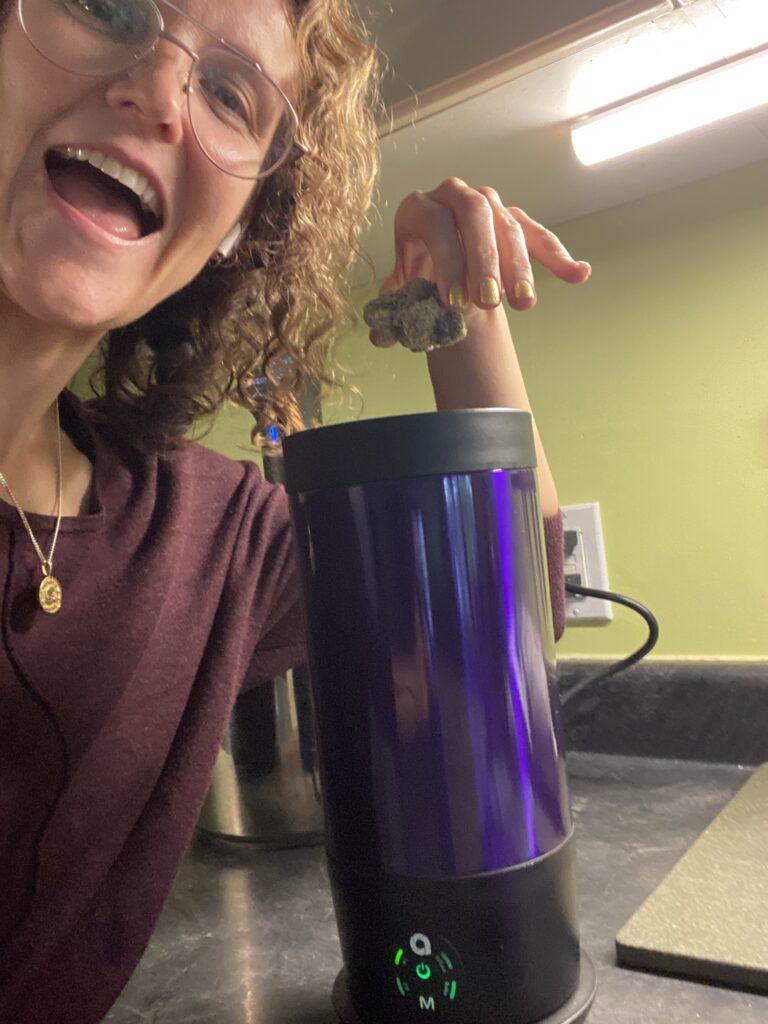
Why Your Oven Is Not a Precision Tool
The standard home decarb method is familiar to most edibles enthusiasts: preheat the oven to a target temperature, put your cannabis in, wait a set amount of time. It seems reasonable. The problem is that ovens are not designed for this kind of precision work.
“It would be amazing if it was just that simple that you could throw it in the oven and trust the oven temperature,” Shanel says, “but ovens are not precision devices. They vary within temperature, even the best ovens, five to ten degrees. And that small temperature difference, even two or three degrees, can make the difference between getting 97% of that available medicine or less than 70%.”
That spread isn’t academic. It’s the difference between a consistent, effective product and one that varies every single time, potentially leading to the over- or under-dosing experiences that make people distrust edibles altogether.
The Ardent devices address this through a design that wraps a thermal core entirely around the cavity, rather than using the top-and-bottom heating elements of a standard oven. Two sensors work together with a smart algorithm to maintain a precise, uniform heat zone throughout the process. The result is lab-grade heating in a countertop appliance.
The closed design also does something the oven can’t: it contains the smell. For anyone who has decarbed in an oven and had that earthy, toasty aroma spread through the house and into the yard, this is not a minor detail.
Get your own Ardent FX.
How Much Cannabis You Actually Need
One of the most persistent misconceptions about edibles is that making them requires large amounts of starting material. Shanel traces this directly back to inefficient decarboxylation.
“In the past, people have had to use an incredible amount of flour or starting material in order to get just a little bit of edibles. The inaccuracies in the process of making edibles can lead to these unfortunate situations.”
When you activate close to 97% of available cannabinoids instead of 50% or 60%, everything changes. A single gram of flower becomes meaningful. The math on what you need to make a 20mg edible shifts dramatically.
“When you’re talking about dispensary products, the THC and CBD are often the least expensive part of the product,” Shanel notes. “When you’re activating correctly, you can use very, very little to make your end products.”
This reframing matters for more than budget reasons. It also removes one of the biggest barriers for people who want to make their own medicine but feel the process requires too much, costs too much, or is too complicated to get right.
Use the Bite Me Dosage Calculator to help figure out the potency of your creations.
Decarb and Eat: Skipping the Infusion Step Entirely
One of the more surprising ideas Shanel brings to the conversation is the concept of instant edibles: decarbing your cannabis and then simply eating it directly, without infusing into butter, oil, or any other fat first.
This isn’t common knowledge because decarboxylation and infusion have become so closely linked in most people’s minds that they treat them as a single step. They’re not. Infusion is one way to deliver activated cannabinoids. It’s not the only way.
“Once you decarb, the THC and CBD are sitting right on that plant material,” Shanel explains. “You can just break it up and put it into whatever. You don’t have to go through that second step.”
She adds context that will resonate with anyone who has made medicated butter for therapeutic use: “I was eating so much butter. I was eating three times a day and I needed the butter in something, so I would end up eating a bowl of oatmeal. I was adding three extra meals a day to my regimen and that’s not what I want to do for my health.”
The practical applications are broader than they sound. Decarbed cannabis can go into capsules, salad dressings, pasta sauce, applesauce, or anything with enough flavor to absorb the taste. For people who want consistent therapeutic doses without cooking, capsules are particularly flexible.
“For those people who aren’t chefs or don’t really make anything, even sticking it into a capsule, anybody can do that.”
The one caveat: infusion still makes sense for applications where texture matters, like smooth topicals, certain beverages, and preparations where gritty plant material would be a problem.
Working with Multiple Cannabinoids
Ardent’s devices can decarboxylate more than just THC-dominant flower. Shanel points to CBG and CBC as cannabinoids that are increasingly relevant and increasingly available.
“CBG used to be present at only close to 1% in most flower, but now you’re starting to see CBG being bred at 10 or 15%.”
CBC has an additional property that makes it interesting: its acid form, CBCA, can convert into different cannabinoids during decarboxylation, behaving somewhat like a cannabinoid stem cell.
The broader implication is that home producers now have the ability to make genuinely customized formulations, blending different cannabinoid profiles in a way that most dispensary products don’t offer. Rather than chasing the highest THC percentage on a shelf, consumers can make deliberate choices about what they actually want from the plant.
Terpenes: What Decarb Does and Doesn’t Do
A reasonable concern for anyone who cares about full-spectrum effects is whether the heat involved in decarboxylation damages terpenes, the aromatic compounds believed to contribute to the overall effect profile of cannabis.
The short answer is that some impact is unavoidable. Terpenes are volatile by nature, and heat affects them. But the degree of impact is manageable.
“What we do is decarb at the lowest possible temperature to get full activation in order to try to limit the impact on terpenes,” Shanel says. “The closed device itself also helps to trap terpenes.”
For people who want to preserve as much of the raw terpene and acid cannabinoid profile as possible, one approach is to blend fully decarbed material with a small amount of unprocessed flower. This gives you the activated THC and CBD alongside THCA, CBDA, and the broader terpene profile from the raw material.
“Really trying to hit all of those different angles when it comes down to treating with the plant.”
On Stigma and the Bigger Picture
Shanel doesn’t limit her work to device engineering. She’s been publicly vocal about cannabis legalization, equity in the industry, and the persistent stigma that shapes how people access and discuss cannabis, from both her position as a business founder and her personal history. She was arrested for cannabis possession, and as an attorney, she was able to fight the charges herself, an experience that deepened her commitment to advocacy.
“Stigma has weighed me down. I was a young mother who used cannabis, and a lawyer who used cannabis. All of these misconceptions about who we are as a community.”
Her view is that honest conversation, combined with accessible tools and real science, is what moves the needle.
“Once people try cannabis and they see the benefit from it, there’s no way people are willing to give that up.”
For anyone in a state without legalization, she has a specific ask: push hard for home grow rights and equity provisions when the conversation comes up. The right to make edibles at home, to control your own medicine, is something worth protecting from the start.
Get your own Ardent device.
Ardent inspired recipe episodes:
- Chocolate Canna Banana
- Canna Flour
- Keto Coleslaw
- Canna Flour Cookies
- Infused Ghee
- Hasselback Potatoes
That’s it for this week friends. Please reach to me, I love hearing from listeners! Direct messages to stayhigh@bitemepodcast.com, or leave a voice message on the podcast hotline.
Support the show by subscribing, sharing, leaving a review or buying me a cookie! Whatever way you choose, I’m grateful that you’re listening.
Stay high,
Margaret
FAQ For Interview with Shanel Lindsay, CEO of Ardent Cannabis
What is decarboxylation and why does it matter for edibles?
Decarboxylation is the process of applying heat to cannabis to convert the inactive acid forms of cannabinoids (THCA, CBDA) into their active counterparts (THC, CBD). Raw cannabis contains very little active THC or CBD. Without decarbing, edibles made from flower will have minimal effect, regardless of how much you use. It is the single most important step in making effective edibles.
Why doesn’t oven decarbing work reliably?
Ovens fluctuate in temperature by five to ten degrees, even high-quality ones. Cannabis decarboxylation requires a narrow temperature window. A difference of two or three degrees can drop your activation rate from 97% to below 70%. You also have no control over airflow, hot spots, or how evenly heat distributes around your material. The result is inconsistency from batch to batch.
What activation rate does the Ardent device achieve?
According to Shanel, Ardent’s lab testing shows an average of 97% activation. That compares to the sub-70% rates that were previously considered the ceiling for home decarbing.
Can you eat decarbed cannabis directly without infusing it first?
Yes. Once cannabis is properly decarbed, the active cannabinoids are present on the plant material itself. You can eat it directly without infusing into butter or oil first. Shanel adds it to salads, pasta sauce, applesauce, and capsules. The key is using a small enough quantity that the texture and taste aren’t disruptive to the dish. For a 20mg dose, you’re typically working with around 0.1 grams of flower.
When should you still use an infusion?
Infusion makes sense when the application requires a smooth or liquid consistency, such as topicals, certain beverages, or dishes where gritty plant material would be a problem. For beauty products in particular, infusing into shea butter or a carrier oil makes far more practical sense than using raw decarbed flower.
What can you add to cannabis capsules to improve absorption?
For people who metabolize edibles slowly or inconsistently, adding a small amount of a fat or digestive support can help. Shanel recommends a drop or two of coconut oil, lipase, or lecithin inside the capsule alongside the decarbed material. These help with fat-binding and absorption. Size zero or double-zero capsule sizes are generally workable for most people.
Can the Ardent device decarb fresh flower?
Yes, but Shanel’s recommendation is to dry the flower for at least 24 hours first to reduce moisture content. Fresh flower decarbed without drying comes out with a texture she describes as steamed spinach, which may be fine for certain applications but is not ideal for most uses.
Which cannabinoids can the Ardent decarboxylate?
THC, CBD, CBG, and CBC can all be decarboxylated in the device. With the increasing availability of high-CBG strains (some now bred at 10 to 15% CBG), home producers have more options than ever to make customized cannabinoid blends. Ardent’s blog carries research links and guides for working with each of these.
Does decarboxylation destroy terpenes?
It affects them. Terpenes are volatile compounds and heat has some impact on them regardless of the device. Ardent mitigates this by operating at the lowest temperature that still achieves full activation, and the closed cavity helps trap terpenes during the process. For those who want to preserve the full acid cannabinoid and terpene profile as much as possible, blending fully decarbed material with a small amount of raw unprocessed flower is a popular approach.
What products does Ardent make?
The original Nova device launched in 2016. The FX, a larger all-in-one device that allows decarbing, infusing, and baking inside one unit, launched in 2020. Ardent is also expanding into consumer product kits, including capsule kits with pre-added excipients like guarana and B12, and a suppository kit for markets where those products aren’t widely available commercially.
Where can I find recipes and educational content from Ardent?
The Ardent website carries a blog with research-linked posts on individual cannabinoids and detailed guides for making various products. Shanel also hosts a monthly live show called Easily Baked with Ardent where she demonstrates recipes and techniques in real time.

[…] the interview: The Perfect Decarb with Shanel […]