Decarboxylation Is Still Sexy (And Everything You Need to Know)
Let’s talk about decarboxylation. I know, I know. You might be thinking: didn’t Margaret already cover this? Yes. Yes, I did. Way back in episode two. But that was over 220 episodes ago, and while a lot of the core information holds up just fine, I’ve learned a ton since then. I’ve talked to experts, tested devices, and made more edibles than I can reasonably count. So consider this the updated, more seasoned, still-sexy version.
If you’ve ever made edibles that did absolutely nothing for you, this step is probably why.
What Is Decarboxylation and Why Does It Matter?
Here’s the quick science, and I promise to keep it painless. Raw cannabis contains THCA and CBDA. Those are the acid forms of THC and CBD, and in that raw state, they are not psychoactive. They won’t get you high. They won’t give you the therapeutic effects you’re looking for. They’re basically locked up.
Decarboxylation is the process of applying gentle heat to remove that acid molecule, converting THCA into THC and CBDA into CBD. Once that conversion happens, your cannabis is activated and ready to do its job.
When you smoke or vaporize cannabis, decarboxylation happens automatically because of the direct heat you’re applying. When you’re making edibles, you don’t get that shortcut. You need to do it yourself, as a separate step, before you infuse.
I’ve said it before and I’ll keep saying it: if you’re skipping the decarb, you are leaving money on the table. Every single expert I’ve had on this show agrees.
Method 1: The Oven (The Classic, The OG, The Fragrant)
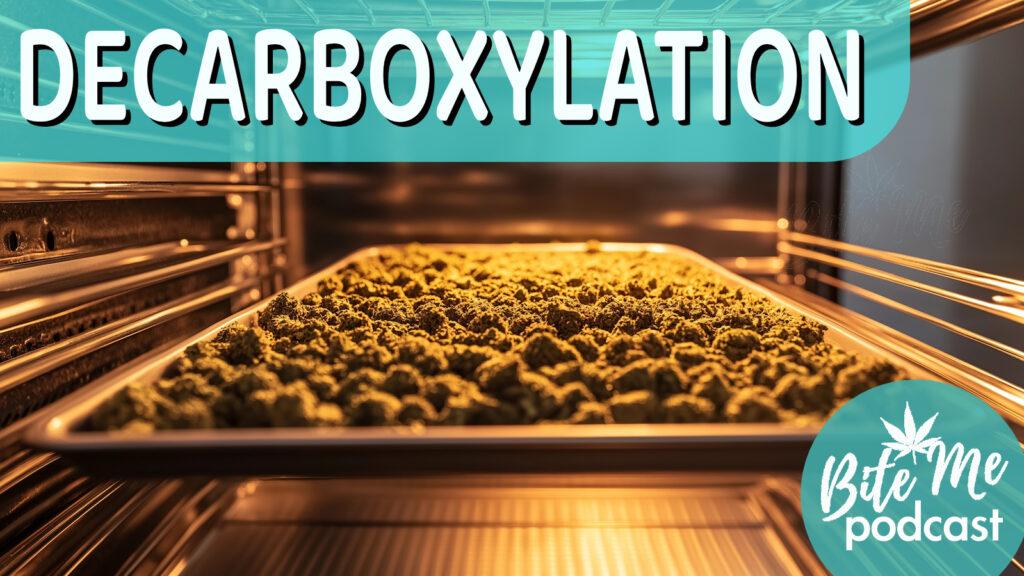
This is where most people start, and honestly? It’s a totally valid method. You don’t need any special equipment. You spread your cannabis on a baking tray and pop it in the oven at 240 degrees Fahrenheit for about 30 minutes. That’s really it.
Decarb at 240F/115C for 30 minutes.
You’ll know it’s done because your cannabis will look toasted and golden, and you will definitely know it by the smell.
That smell is the big drawback. If you’ve ever done an oven decarb, you know. It is a distinctive, lingering, “everyone in the home now knows what you’re up to” kind of smell. It does not dissipate quickly. If you have roommates, a partner who isn’t on board, kids, or nosy neighbors, this method can create some awkward front-door moments with your delivery driver.
One smell-mitigation tip that listener Wayne passed along to me: place your cannabis in a large mason jar and cover the top with foil before putting it in the oven. Don’t use the rubber-sealed lids that come with the jar because those will likely melt, and that is a problem you do not want. The foil creates a loose seal that can trap a good portion of the smell inside the jar. Let it cool completely before lifting the foil. I haven’t personally tried this method because I’ve moved on to other options, but it makes good sense and I think it would help significantly. Just don’t expect it to trap every last molecule of scent.
As for getting obsessive about the exact temperature, I wouldn’t stress too much. Chef Brandon Allen, who came on the show to talk about the science of edibles, shared a more precise temperature recommendation based on lab research. But he was also upfront that he was working in a commercial kitchen where oven accuracy is far better than what most of us have at home. Your oven probably runs a little hot or a little cold, and that’s fine. 240 for 30 minutes is a solid rule of thumb, and you’ll still end up with great, activated cannabis.
Check out the episode: The Science of Edibles with Chef Brandon Allen. Also see the The Complete Guide For Great Edibles.
Method 2: The Ardent (My Personal Favourite for Decarb)
I got the Ardent primarily for decarboxylation, and it remains my go-to for this step. I had Shanel Lindsay, the CEO of Ardent Cannabis, on the show, and she dove deep into the science of why this device works so well. The design is built specifically around creating an even, precise heat that wraps gently all around your cannabis. The claim is that it activates more of your cannabinoids than other methods because of how controlled that heating process is.
The smell situation is basically a non-issue with the Ardent. The lid that comes with the device contains the smell so effectively that unless you have a truly superhuman nose and you’re standing right over it, you likely won’t notice much at all. Ardent also sells a separate scent shield for anyone who needs extra discretion, though personally I’ve found the standard lid does the job.
Capacity is decent. You can fit roughly an ounce into the canister, sometimes more, which is great if you like to decarb in batches so that your cannabis is ready to go whenever inspiration strikes. That’s honestly how I prefer to operate because making edibles is way more fun when you’re not doing every single step in one marathon session.
See the interview: The Perfect Decarb with Shanel Lindsay and see more Ardent.
Method 3: The LĒVO (Decarb and Infuse in One)
The LĒVO is the newest addition to my device lineup, and I’ve mainly used it for infusions rather than decarbing. In theory it handles both, and the option to decarb and infuse in the same machine without transferring anything is genuinely appealing.
The main limitation is capacity. The LEVO doesn’t hold as much cannabis as the Ardent for a decarb, so if you like to do larger batches, it may not be your first choice for this step. That said, if you have a lower tolerance and you’re not working with large quantities at a time, it could be a perfect all-in-one option. The dispensing mechanism is also noticeably cleaner and easier than other machines, and yes, it looks great on the counter.
See the LĒVO User Guide.
Method 4: The Magical Butter Machine (Great Infuser, Needs Help with Decarb)
Let me be clear here: the Magical Butter Machine itself does not decarboxylate. It’s an infuser, not a decarber. However, the company does make a decarb box that you use in your oven alongside the machine. I haven’t personally used it, but the idea is that it provides better temperature control than a bare baking tray and helps contain some of the smell. If the Magical Butter Machine is already your main infusion device, this is probably worth exploring as a complementary step.
The Magical Butter Machine shines in its capacity. It holds more than most other infusion devices on the market, which is why it has such a loyal following.
Check out the Magical Butter Machine.
Method 5: The Sous Vide / Immersion Circulator
This one is a favourite of cannabis chef Monica Lo, who has been a guest on the show and does beautiful work with edibles. The basic idea is that you seal your cannabis in a bag, submerge it in a water bath brought to a precise temperature by an immersion circulator, and let the heat do its thing.
The biggest advantage here is temperature precision. Unlike a home oven that runs hot or cold, an immersion circulator holds your water bath at exactly the temperature you set, for as long as you need. That kind of consistency is genuinely impressive. I use my sous vide for all kinds of things: yogurt, butter, chicken, and more. It’s a very versatile tool.
There are a couple of practical downsides. First, the time commitment is longer. Where an oven or Ardent gets the job done in about 30 minutes, a sous vide decarb typically takes a few hours at a lower temperature. Second, bags can float, which can affect how evenly things heat. You can work around this by using a jar in the water bath instead, or by using a container with a weighted screen on top. It’s not a dealbreaker, just something to plan for.
If you already own an immersion circulator and love using it for cooking, this is a fun and precise method to try for your decarb.
Find the interview: DIY Edibles with Monica Lo.
You Don’t Always Need an Infusion
This one surprises a lot of people. Once your cannabis is decarboxylated, it’s activated. That means you can use it directly in food without making an infused oil or butter first.
I tried this with cookies based on a method from Ardent’s website where you blend your decarbed cannabis directly into flour and bake with it. The results were legitimately good, and the weed flavor was much less noticeable than I expected. You could also stir it into peanut butter, toss it on a salad with hemp hearts and dressing, or mix it into other foods where the texture won’t be an issue.
Will there sometimes be a slightly green or earthy taste? Possibly. But depending on what you’re making, that can actually work in your favour, or get masked entirely by other flavors. It’s an experiment worth trying.
Once you add it to an infusion, of course, the possibilities really open up. But knowing you can skip that step entirely and still make effective edibles is genuinely useful, especially on days when you want to move fast.
Try shipping the infusion: Canna Flour episode + Canna Flour Cookies episode.
Listen to this episode:
That’s it for this week friends. Please email me any questions, comments, pictures of your creations or anything else, I love hearing from listeners! Direct messages to stayhigh@bitemepodcast.com or the podcast hotline.
You can also support the show by subscribing, sharing episodes, leaving a review or buying me a cookie! Whatever way you choose, I’m grateful that you’re listening.
Stay high,
Margaret
Frequently Asked Questions For Decarboxylation
Do I really need to decarboxylate? Can’t I just skip it? You can skip it, but you should expect dramatically weaker results. Raw cannabis in its acid form (THCA, CBDA) is not psychoactive and won’t deliver the effects you’re after. Every expert in this space will tell you the same thing: decarboxylation is not optional if you want potent, effective edibles.
Does the decarb happen automatically during infusion? Somewhat, but not reliably or completely. Infusing at low temperatures over time does cause some conversion, but it’s inconsistent and incomplete compared to a dedicated decarb step. If you want to maximize how much of your THC or CBD actually activates, do the decarb separately first.
What temperature and time should I use for the oven method? 240 degrees Fahrenheit for approximately 30 minutes is a solid, reliable rule of thumb for most home ovens. Don’t obsess over hitting a precise temperature. Home ovens are variable, and a few degrees in either direction won’t meaningfully affect your results.
How do I know when the decarb is done? Your cannabis will have a slightly toasted, golden-brown color when it’s ready. And if you’re doing an open oven decarb, you will absolutely know by the smell.
Which decarb method is best for controlling smell? The Ardent is my top recommendation for smell control. The lid that comes with it is highly effective. The sous vide method and the mason jar oven method are also reasonable options for reducing odor. The open-tray oven method produces the most noticeable smell by far.
Can I decarb a large batch at once and store it for later? Yes, and honestly I recommend it. Decarbing in larger batches means your cannabis is ready to go whenever you want to infuse or cook with it. Store your decarbed cannabis in an airtight container in a cool, dark place. This is one of the best ways to make your edibles practice more efficient and enjoyable.
Do I need an expensive device to decarboxylate? Not at all. The oven method works and costs nothing extra. Dedicated devices like the Ardent or LEVO offer advantages like better smell control and potentially more complete activation, but they are optional upgrades rather than necessities. Start with your oven if you’re just getting going.
Can I use decarbed cannabis directly in food without infusing it first? Yes. Once decarboxylated, cannabis is activated and can be incorporated directly into recipes. Blending it into flour for baked goods is one popular approach. The texture and flavor will be present, but it can work well depending on what you’re making.
Timestamps for Decarboxylation Audio
Episode 2: Decarboxylation (00:00:05)
Marge revisits the topic of decarboxylation, discussing the changes since her last episode on the subject.
Episode 223: Review and Appreciation (00:01:07)
Marge shares a five-star review from a cannabis grower, and expresses gratitude for the support.
Let’s Be Budz Show (00:04:23)
Marge talks about her recent appearance on the Let’s Be Budz show, where she discussed decarboxylation and shared tips and tricks for making edibles.
The Ardent Cannabis Device (00:10:00)
Discussion about the Ardent Cannabis device, its ability to gently heat cannabis, and its effectiveness in mitigating smell.
The Levo Infuser (00:11:04)
Overview of the Levo infuser, its limitations in holding larger amounts of cannabis for decarboxylation, and its dispensing method for infusions.
The Sous Vide Method (00:14:01)
Explanation of the sous vide method using an immersion circulator, its versatility for various culinary applications, and the advantages and drawbacks of using this method for decarboxylation.
The timestamp’s title (00:19:00)
Discussion about the versatility of edible cannabis and the invitation to ask questions or share the episode with others.
The timestamp’s title (00:19:57)
Introduction to the “Marge Recommends” page where different products and services related to edibles are reviewed and discussed.
The timestamp’s title (00:19:57)
Encouragement to decarboxylate cannabis for more potent edibles and a closing message to stay high until the next episode.
Marge (00:00:05) - Hey welcome back friends. This week we're talking crab oscillation. Welcome to Bite Me, the show about edibles where I help you take control of your life. I'm your host and certified Ganjier. Marge and I love helping cooks make safe and effective edibles at home. I'm so glad you're here. And thank you for joining me today. Welcome back, my friends. Thank you so much for being here. Have I told you recently how much I appreciate you if you're just tuning in for the first time today, thank you for taking the risk on this episode. Hopefully you'll learn a little bit about decarbonization. And for those long time listeners, yes, I am revisiting this topic, but the last time I had a a podcast episode specific to decarbonization that was a solo episode was episode number two. That's right. I had to go back and listen to it to see what I covered and got. A lot of things have changed since I first recorded that episode, except a lot of the information. That episode was evergreen, but I've just learned a lot in four years of podcasting.
Marge (00:01:07) - And here we are in episode 223, I believe. So we've gone from episode 2 to 223, and I've learned a few things in between. And if you've been around here listening for a while, you probably have to. Before we get into today's episode, I just wanted to share a review with you that I got recently, and these types of reviews really help new people find the show, which is always a challenge when you're an independent podcaster and it really does. It really does help. And I of course, as a podcast host, there's nothing better than the feeling that you're helping people make great edibles, whether they're huge foodies or not. And this all makes sense. When I read you this podcast, it was a five star rating and review entitled one of my favorite podcasts. I'm not at all a foodie, but I am a cannabis grower. This show has broadened my horizons beyond the ganja butter I've been making for 25 years. My wife, who is a foodie, is really helping me make some of the recipes.
Marge (00:02:10) - The host, Marge, has a professional quality radio voice and keeps things fun and interesting to listen to. Keep up the good work! And that review came from citizen from the United States. I'm sure I totally butchered that screen name and I'm really sorry about that. I do believe I know who you are, so I do appreciate the review, and I'm so happy to hear that you are broaden your horizons, trying some new things and experimenting in the kitchen with your wife, because to me, that's a really fun pastime, and making infused food that you can enjoy together afterwards is a great way to to share time together. And I love to hear that I have a professional, quality radio voice because like most people, when I hear my own voice, I cringe a little bit. But I'm glad to hear that I'm not scaring too many people off with my voice in any case. So before I get into the meat and potatoes of today's episode, which will probably be on the shorter side, just a few things it has been.
Marge (00:03:10) - I hope the audio is okay for this particular episode, because I've switched my office around in in the house. I'm selling my house right now and things have been topsy turvy, let's just say, because we're getting ready to list and there's so much work that goes into listing, and it's dealing with contractors and doing a lot of the work yourself. And because that podcasting money hasn't hit yet, of course, and there's just an endless list of things to do to make the house as pretty as possible so that when people walk in, they're just wowed. And who wouldn't want to buy the house and where? Bite me. The show about edibles was born. I mean, that should be in the listing probably when they post it online, but it's been very busy. And of course, unfortunately, it's probably taken away my focus a little bit from doing the show because I've had a lot of other things on my mind. So let's get into it. De carboxylate. I think one of the reasons I think it's been coming up a lot lately is because I was recently on the Let's Be Buds show, and with Uncle Rick and Spartan Girls, and there's another fellow on there that does a lot of the producing for it, and I forget his name offhand.
Marge (00:04:23) - My apologies. I haven't linked to that on the website yet because I have like a Find Marge in the media, or find where I've been a guest on a show and I was on that one recently. I'll have to link to that one there. But it was a fun episode and we talked a lot about decarbonization. And of course, when I'm going on another show is often people are asking me about about the nuances, the tips and tricks and all the different things when it comes to making edibles, because of course, that's my jam. And so I went back and I listened to the d carb Oscillation is sexy episode. That was episode number two that I mentioned earlier, and I talked about the oven method in that episode, and I still stand by that information. Most people, when they're just getting started and they're not ready to invest in all kinds of fancy equipment or anything like that, would probably start with the oven method. And for obvious reasons, most people have an oven that they have access to.
Marge (00:05:16) - And it's simple. You don't need any fancy equipment. You're using what's already in your your living space, and you just need a pan to put it on, the weed to put on the pan, and you can throw that in the oven. Of course, there's big drawbacks to that. As anybody who has done decarbonization before, it's going to make your house very fragrant. Fragrant of the smell of toasting weed, which is a very distinctive smell. And in my experience, that smell does not dissipate quickly. So if you have roommates, if you have significant others, children, nosy neighbors, people who just can't stand the smell of weed, it's really a drawback to that particular method. Effective, yes, but maybe not the best one, depending on your living situation. Now, I haven't done it that way in a long time because I have other methods that I like to do instead, mainly because of the smell, because I have had. I live in a relatively large house. Well, for the foreseeable future anyway.
Marge (00:06:11) - Who will see how long that lasts? But hopefully it'll sell quickly. This, like the kitchen, isn't too far from the front door, I guess. And when I've discarded before, people have come to the front door and you're like, oh shit, they're going to be able to smell. So if you have like a delivery driver coming to your door, dropping off an Amazon package or whatever the case is, they're going to notice that smell. It is distinctive. So of course there may be ways to mitigate that smell. And I've had a few people suggest things over the years, which I have to admit, I haven't tried myself, but I think would work quite nicely. And the main one is to put your cannabis in a large mason jar, and then put a foil lid over over the top of that mason jar and put that in the oven. And of course, the reason being if you use the lids that come with it, the rubber on, that's probably going to melt in the oven.
Marge (00:07:04) - So you don't want to do that. And risk, I don't know, maybe ruining your weed and creating other smells in your kitchen that are so nice. But if you put the foil lid on top, the idea is that it will trap a lot of the scent inside the jar, and then you let it cool before you, before you take the lid off to also help keep that scent in the jar. As I said, I haven't tried that method myself, but it reasonably stands to reason that it would work quite nicely. Do I see it necessarily trapping all of the smell? Probably not. I think some of it's going to escape. I mean, you can try putting the foil lid on as tightly as possible, but, you know, I think some of that smell is still going to escape. But if you are working with the oven method, that is going to be just fine. 250 for about 30 minutes for your cannabis. I would still say that is a good rule of thumb.
Marge (00:07:58) - I did have Chef Brendan Allen on my show who suggested a more scientifically proven temperature to activate more of the THC or CBD, and I can't remember off the top of my head what it was, but I'll put it in the show notes. But at the end of the day, he does admit he was working in a commercial kitchen and your home oven is going to be significantly less accurate than any oven you're working with in a commercial setting. So while you might go up ten degrees, down ten degrees, I don't think it really matters. You're splitting hairs at this point. If you activate a little bit more, a little bit less of the THC, CBD, then again, you're splitting hairs. You're still going to have great effective weed to use in your infusions and in whatever you end up cooking. So I'm not sure I would stress too much about that. Two 4250 rule of thumb about 30 minutes, give or take. You'll usually know by the color of the cannabis as well, because it looks toasted.
Marge (00:09:04) - And you will definitely notice the smell unless you're using the jar method. And if and this was recommended by a listener. Hi Wayne, if you're listening to this, he was the first person to ever recommend this to me. And again, I haven't tried it myself because I have other methods in which that I have. I choose a D carb now because I have those at my disposal now. Most of the machines, the device is on the market that will allow you to infuse. Many of them also have some carb options. And the ones the machines that I've worked with are primarily the magical butter machine. That was the first one I ever got. And it's a great, great device, large capacity. That's why people like it. Then I got an ardent and one of the main reasons I got it was for the purpose of d carving. And I did have Chanel Lindsay, the CEO of Ardent Cannabis, on my show probably a couple of years ago by now. And that was a great episode.
Marge (00:10:00) - And she really got into the nitty gritty of the science behind the carb and and it's fascinating because she takes all the signs and they do so much lab testing over there. I really like what Ardent Cannabis is doing, and they have created this device, which will gently heat all around the cannabis that you stuff into this ardent. So I'll get to that in a second really. But the third device I have is the Levo. That's the most that's the newest addition to my lineup of infuser, and it does de carb. I have not used it for de carbon yet. I've only used it for infusions. The only drawback I see offhand is that you just it just doesn't hold as much cannabis for a d carb as you might want, because I personally like to do a larger batch at a time so that I have the weed ready so that when I when the creativity or the inspiration strikes me, I can just go in and make my infusion. Because sometimes if you if you have to do the de carb infusion and cook and bake something all in one go, just take so much longer and you're less likely to follow through, in my humble opinion.
Marge (00:11:04) - So no magical butter machine, while wonderful, does not actually de carb in the device itself. They do have a box of some kind that goes into the oven, and I'm assuming that it is something. It's has a temperature control with it as well of some kind or some way to show the temperature. I'm not too familiar with it because I haven't used it and I haven't tried it, but I think the idea is you can in the oven with this little box, and it's going to help mitigate the smell and give you a nice, good Decarbia cannabis. The ardent is great if you're looking for something to really help mitigate the smell. Now it does come with like a scent shield. Sorry, it doesn't come with it. It comes with a lid, which I find extremely effective. You wouldn't know that you're decarbia in your kitchen because that tends to be where I where I do it. Most often you don't notice the smell less. Maybe you're standing right next to it, but when you compare that to an oven de carb, the smell is pretty well nonexistent unless you're living with a super smell.
Marge (00:12:03) - Or as some people have told me that they do, live with super smells who may notice that smell. But Arden did also come out with a scent shield. So if you are particularly concerned about smell, you can buy this extra lid that goes on it that allows you to mask the smell even more, not mask, but hide the smell even more. I haven't tried that. I find the regular lid that comes with it suitable for my purposes. I do live in Canada, however. Keep in mind. So I am in a place where it's legal for me to work with cannabis. The one thing I do like about the ardent is because it was sort of originally designed for the de carb. It does suggest that it will activate more of the THC or CBD in your cannabis than other methods, just because of the gentle heating and the very even heating and precise temperatures. So I like that about it. And I think you can stuff an ounce or two into the canister at a time. So it allows you to do, you know, batches or larger batches.
Marge (00:13:09) - You're not just doing a few grams, you can do an ounce or two. I think it might be an ounce, but I'd have to go back and look. And then of course, the livo. I haven't again, I haven't tried that for the D carb. I could see how it would help mitigate the smell. But the only drawback, like I said, is that it is going to not hold as much weed. But if you are somebody who has a lower tolerance, you don't necessarily need to be doing large batches at a time. Then this device could work great for you because you can dicamba and then infuse it in the same thing. Yes, you can with the ardent as well. But the one great advantage to the level, of course, is its dispensing method, because it's really clean and easy. And that's and it looks cool too. Now the next method I have heard people try and I know some people swear by it is the sous vide method using an immersion circulator, and some people swear by this.
Marge (00:14:01) - I know that Monica Lo, who's also been a guest on the show, who has the blog. Weed and she does a lot of work with immersion circulators, including her de carboxylate. And basically you can d carb in a in a water bath. And the advantage to using this type of device is that it is so versatile. I heard her say that sometimes she can set things to a certain temperature, because basically what you're doing is you're using an immersion circulator. You clip it to the side of a container, like a pot or some kind of specialized container, and it brings a water bath to a very precise temperature. So unlike your oven, it will hold and maintain that temperature for as long as you need it to. So I've done all kinds of things with my sous vide, funnily enough, except for a d carb, but I have made things like yogurt and butter and chicken and like all kinds of stuff. And sometimes I've cultured yogurt in my in my sous vide, and it'll hold that exact temperature for the 36 hours I needed to hold it for.
Marge (00:15:09) - So one of the advantages to an immersion circulator is that it's a pretty unique but versatile tool that you can use for a whole lot of other applications. And if you start diving into that, that's a real rabbit hole that you can go down. And of course, because of the nature of the device, you just set it and you walk away and forget it, much like a lot of the other ones too, of course. But now I have heard people say when they put them in the bags that sometimes the bags will float, and I'm not sure how ideal that is. You could possibly put it in a jar and put it in the bath as well. I'm assuming that would accomplish the same thing and help keep it weighted down. Some of the containers that the immersion circulators can come with. We'll have some kind of screen that you can put on top to prevent it from bobbing to the top. And another drawback, of course, is that usually it takes longer, it'll be at a lower temperature, but it's going to take a few hours instead of, say, 30 minutes in your oven.
Marge (00:16:05) - But that's another device you can try that's versatile and relatively cost effective compared to some of the other options that I just mentioned. Now, of course, you may be thinking if you're relatively new to the show, why would I carb anyway? Can't you just, you know, doesn't it kind of get discarded when you do your infusion? And I've been asked this question so many times, and it's a great question that a lot of people who are new to making edibles might have. I can't say that I'm a huge science person, but because of the nature of my show and I've talked to so many people about edibles, I've talked to experts like Chanel Lindsay, who created a whole device around oscillation. I've talked to cannabis chefs, all kinds of people, and they would all say the same thing. You need to do the de carb separately. It is key to creating more potent edibles. And as I was saying in episode number two, if you're not decarbonizing, you're leaving money on the table. And I still stand by that sentiment.
Marge (00:17:02) - So decarbonization can be sexy. And essentially what you're doing is you're gently heating your cannabis so that the acid molecule, because in its raw form, cannabis is THC or CBD. A and you're removing that acid molecule through the heat and that gives you your psychoactive THC or CBD or whatever cannabinoids you're working with. And when you're smoking cannabis, that happens when you apply heat to the end of your joint or your bone or your vaporizer or heating that up. And it's the same kind of principle. But with infusions, you take that extra step. And when you do that, you're going to have far more potent edibles. And in fact, I know ardent has often talked about the instant edible, which is interesting because they have lots of recipes on their website, and I've tried some of them myself. I can probably link to some of those in the show notes as well. Lots of links linked to in the show notes, but what will you'll find is the you can take that described cannabis and put it right in with something like flour.
Marge (00:18:08) - You don't even necessarily have to put it in an infusion. Now of course this is going to change a few things I. And you might have more of a green taste, but depending on what you're making, it can lend itself well. It can mask the taste. And I tried it with some cookies before they had you sort of blend up some of your cannabis directly in with some flour, and then use that flour to make cookies. And it worked. It was great. And I don't recall tasting the a weed taste very much. So. That was an interesting experiment that I encourage you to try, because they also suggest, and I haven't tried this necessarily, but you could take some of that cannabis and put it right on a salad, maybe with your hemp hearts and some other salad dressings. Or you could put it. I don't know, in peanut butter or like, there's all kinds of things you could do with it. You know, you don't necessarily have to put it into an infusion.
Marge (00:19:00) - Now, once you put it in an infusion, of course, you can do so many other things with it. The the things you can do with edible cannabis is just fucking incredible. And I love it, which is why we're here at episode 223. And I thought this was going to be a short edible, but it turns out there's lots to talk about when it comes to decarbonizing, but I think I'll leave it there. And of course, if you have any questions, by all means, please let me know. You can hit me up on the podcast hotline or by email. And if you enjoyed this episode and you know somebody who has questions about decarbonize, by all means please share it with them. And sharing is caring. You can always stay up to date with the newsletter. And of course, you know what else is sexy. The products and services on the Marge Recommends page. And I've been adding things over there. So some of the things I mentioned, I have to think I know I've done the I don't know if I've done the magical butter machine, I know I've done the Levo and the.
Marge (00:19:57) - Anyway, I'm creating product pages, if you will, for different products and services that I have used myself and sort of giving you like the pros and cons of each, just to give you a better idea of what you're getting into before you decide you want to buy one of these devices, because some of them are an investment. And of course, there's deals and discounts over there as well. So consider using the products and services on the Marge Recommends page. Make use of those product pages where I sort of dive into how they work and warranties and all that kind of thing. And don't forget to d carve, my friends. You will be glad that you did, and you will notice how much more potent your edibles are. So I'm going to keep packing and cleaning and doing all that fun stuff. And until next week, my friends, please stay high.
Sign up to receive email updates
Enter your name and email address below and I'll send you periodic updates about the podcast.

[…] Decarboxylation Is Sexy […]