A Deep Dive into Cannabis Infused Ghee
Today we’re doing an ingredient big bite. We are looking into the world of ghee. If you’ve never used it before, or maybe you’ve heard of it but you’re not sure it’s worth the effort, this one is for you. By the end, you’ll be ready to swap out your butter or coconut oil for this golden, buttery goodness.
What Is Ghee?
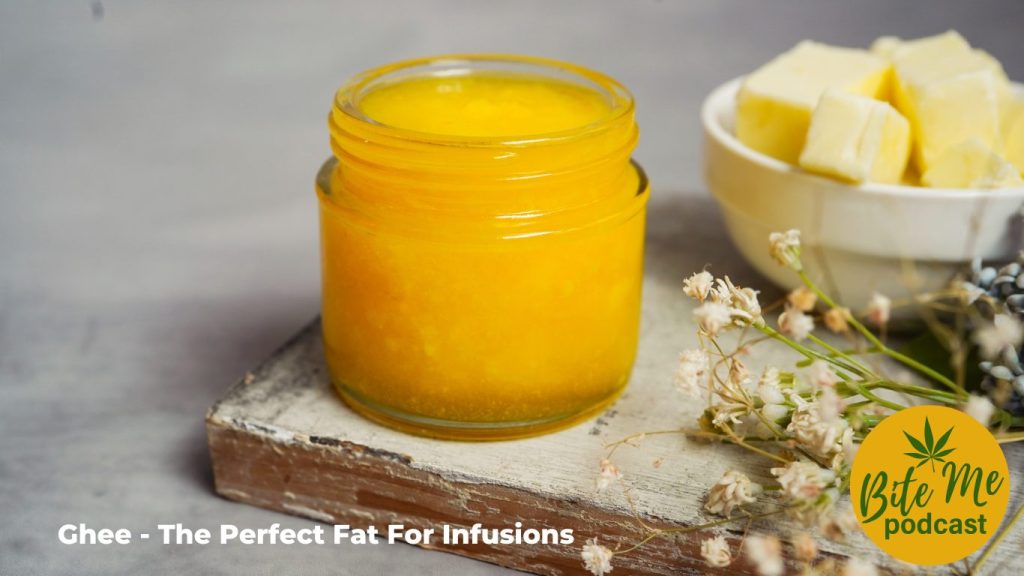
Ghee is a form of clarified butter that has been used in Indian and Ayurvedic cooking for centuries. It’s made by slowly simmering butter to remove the water and milk solids, leaving behind pure butterfat.
If you’ve been making edibles for any length of time, you already know that THC loves fat. Cannabinoids want to bind to fat, and that’s exactly what makes ghee such a wonderful thing to infuse. Here are a few other reasons it earns a spot in your infusion rotation:
Higher smoke point. Regular butter burns at 350°F. Ghee handles up to 485°F, which makes it perfect for cooking and baking without that nasty burnt butter taste. That range opens up a lot of cooking situations.
Lactose-free. The milk proteins, including the casein and the lactose that most people are sensitive to, are removed during clarification. If dairy gives you trouble, ghee is a genuinely useful alternative.
Rich, nutty flavour. Ghee has a deep, caramelized taste that’s way more interesting than plain butter. It makes everything taste better, full stop.
Nutrient-dense. It contains fat-soluble vitamins A, D, E, and K, and has been used in Ayurveda for centuries for its supposed healing properties.
Listen to this episode:
Why Ghee Is Ideal for Infusions
Beyond the cooking benefits, ghee is a game-changer for edibles specifically.
The nearly 100% fat content means you get highly efficient cannabinoid extraction. THC and CBD bind to fat, so more fat equals more efficient infusion. Straightforward.
Ghee also has a long shelf life because it contains no water. Regular infused butter can spoil faster than you’d expect, because the introduction of plant material makes it more susceptible to spoilage. Ghee sidesteps that. Stored properly, it can last months at room temperature and longer in the fridge.
The texture is another advantage. Unlike coconut oil, which can get grainy, ghee stays silky and smooth. That matters in baked goods and savory dishes alike.
And the versatility is real. Sweet or savory, ghee works beautifully for both. Cookies, brownies, drizzled over roasted vegetables, stirred into morning oatmeal. Your kitchen is the best dispensary you’ll ever have, and ghee gives you serious flexibility in how you use it.
How to Make It
Here’s what you need: ghee, decarbed cannabis of your choice, and a saucepan, double boiler, or slow cooker. You’ll also want cheesecloth or a fine strainer to remove the plant material after infusion.
Step 1: Decarb your cannabis.
Bake at 240°F for about 30 minutes. You will smell it. That’s normal. This activates the THC or CBD. If you use an Ardent, they do claim higher activation rates. Already-vaped cannabis from a dry herb vaporizer is another option that skips this step.
Step 2: Melt the ghee on low heat.
Use a double boiler if you can. It helps keep the temperature stable, which matters because THC starts to degrade over 250°F, even if the ghee itself isn’t burning.
Step 3: Add the decarbed cannabis and simmer.
Let it go on low for a couple of hours, stirring occasionally. If you prefer the mason jar method, just add both into the jar, set it in a pot of simmering water, and top up the water as needed.
One interesting note on infusion time: I had a guest on the show who argued that much of the THC binds to fat relatively quickly, and that very long infusion times actually extract more of the undesirable stuff, like chlorophyll, which is why you sometimes get that deep green color. I haven’t run my own experiments on this yet, so I’m still recommending two hours. But it’s worth watching that space. Update: turns out the amount of THC extracted after the first 30 minutes is marginal! See more on the this topic.
Step 4: Strain and store.
Let the infusion cool a bit first. Then strain it through cheesecloth into a clean glass jar, squeezing out everything you can. Store in an airtight container. It’ll last several months in the fridge.
Step 5: Label it.
Always. Include the potency information. Don’t skip this. You don’t want anyone dosing themselves by accident.
For potency math: if you’re using one cup of ghee to 3.5g of decarbed cannabis, you can work backwards from there using the free Bite Me Dosage Calculator.
How to Use It
Once you’ve got a jar of infused ghee in your fridge, here’s where it earns its keep:
Baking. Swap it one-for-one for butter in cookies, brownies, cakes, whatever you’re making.
Sautéing and cooking. The high smoke point makes it great for eggs, vegetables, and seared meats. Just remember: the ghee itself can handle the heat, but the THC can’t. Keep temperatures in check when you’re using the infused version, or blend infused and non-infused ghee to stretch your dose across a full recipe.
Drizzling. This is honestly my favourite way to use it. Melt it gently and pour it over popcorn, pasta, roasted potatoes, vegetables. You’re not cooking anything at high heat, so you’re not losing cannabinoids.
Warm beverages and oatmeal. Stir it into coffee, tea, or warm oatmeal. It’ll be a little oily since fat and water don’t fully mix, but you’ll still get everything you’re after.
A Note on Dosing
Because ghee is so efficient at absorbing cannabinoids, it can be quite strong. Say it with me: start low and go slow. Wait at least two hours before considering more. If you’re brand new to edibles, I’d say try a small amount and wait until the next day before trying again. Residual effects are real, and you want a clean read on how your body is handling it.
If your infusion turns out stronger than expected, just dilute it with regular, non-infused ghee. Simple fix.
Give It A Try
Ghee doesn’t get nearly enough attention in the edibles world. Most people think butter, then coconut oil, and stop there. Both are great. But they have limitations that ghee simply doesn’t share.
If you’ve made something with infused ghee, I want to hear about it. Tag me on Instagram @BiteMePodcast or send a message. And if this episode was useful, share it with someone who’d appreciate it, or leave a five-star review. It helps more than you know.
That’s it for this week friends. Please email me any questions, comments, pictures of your creations or anything else, I love hearing from listeners! Direct messages to stayhigh@bitemepodcast.com or the podcast hotline.
You can also support the show by subscribing, sharing episodes, leaving a review or buying me a cookie! Whatever way you choose, I’m grateful that you’re listening.
Stay high,
Margaret
FAQ’s For Cannabis Infused Ghee
What exactly is ghee, and how is it different from butter?
Ghee is clarified butter. Regular butter contains water and milk solids along with the fat. When you simmer butter slowly and strain it, the water evaporates and the milk solids are removed, leaving behind pure butterfat. That’s ghee. The result is a more concentrated fat with a richer, nuttier flavour, a much higher smoke point, and no lactose. If you’ve never tried it, think of butter’s more interesting, longer-lived cousin.
Why is ghee better for cannabis infusions than regular butter?
A few reasons. The nearly 100% fat content means cannabinoids have more to bind to, which makes for a more efficient extraction. Because there’s no water in it, ghee also has a longer shelf life than infused butter, which can spoil faster once plant material is introduced. And the smooth, silky texture holds up better in both baked goods and savory dishes than coconut oil, which can get grainy.
Do I need to decarboxylate my cannabis before infusing ghee?
Yes, always. Decarboxylation activates the THC or CBD in your cannabis. Without it, you’re infusing raw plant material that won’t produce the effects you’re looking for. Bake your cannabis at 240°F for about 30 minutes before it goes anywhere near the ghee. If you have a device like an Ardent, that works too and tends to produce higher activation rates. Already-vaped cannabis from a dry herb vaporizer is another option that skips the decarb step entirely.
How long should I infuse for?
The standard recommendation is around two hours on low heat. That said, there’s emerging evidence that cannabinoids may bind to fat faster than we’ve traditionally assumed, and that very long infusion times can actually pull more undesirable plant material like chlorophyll into your infusion, which is what gives it that deep green colour. For now, two hours is a reasonable target. Keep an eye out for updates on this one.
My infusion turned out really strong. Did I do something wrong?
Not necessarily. Ghee is highly efficient at absorbing cannabinoids, so it can produce a potent infusion even at relatively modest ratios of cannabis to fat. If it’s stronger than you wanted, just dilute it. Blend your infused ghee with plain, non-infused ghee until you reach the potency that works for your recipes and your tolerance. It’s a simple fix and a good reminder to always calculate your dose before you cook with it.
How do I figure out the potency of my cannabis infused ghee?
Start with what you know: the weight of the cannabis you used and its THC percentage. From there you can work out the approximate milligrams of THC per tablespoon. The free Bite Me Dosage Calculator walks you through the math. If you’re making large batches regularly, a testing device like a tCheck can give you more precise numbers, though it’s a bigger investment.
Can I cook at high heat with infused ghee?
Partially. Ghee itself handles high heat well, up to 485°F. THC does not. Cannabinoids start to degrade around 250°F, so even though the fat won’t burn, your infusion can lose potency at higher cooking temperatures. The best approach is to use infused ghee for lower-heat applications like sautéing on medium-low, baking at moderate temperatures, or drizzling over finished dishes. For high-heat cooking, use plain ghee and add your infused version at the end.
Is ghee safe for people who are lactose intolerant or dairy sensitive?
For most people, yes. The clarification process removes the casein and lactose that cause reactions in people with dairy sensitivities. Ghee is widely used as a dairy-free alternative for this reason. That said, if you have a severe dairy allergy rather than a sensitivity, check with your doctor before assuming ghee is safe for you.
How should I store infused ghee, and how long does it last?
In an airtight glass jar in the fridge, infused ghee will keep for several months. Because it contains no water, it’s naturally more shelf stable than infused butter. Always label your jar with the potency information before it goes into storage. You do not want someone helping themselves to it without knowing what they’re eating.
What are the best ways to use infused ghee?
Drizzling is probably the most practical because you melt it gently and pour it over finished food, so you’re not exposing it to high heat or risking cannabinoid loss. Popcorn, pasta, roasted vegetables, potatoes: all great options. You can also stir it into warm beverages like coffee or tea, mix it into oatmeal, or swap it one-for-one for butter in baked goods. Sautéing works too, just keep the temperature moderate. The rich, nutty flavour makes everything taste better, and that’s before you factor in the rest of what it does for you.
Timestamps For Episode Audio
Introduction (00:00:04)
Margaret welcomes listeners and introduces the topic.
Cannabis Trivia (00:01:19)
Engaging trivia segment where Margaret tests listeners’ knowledge about cannabis-related quotes.
What is Ghee? (00:03:24)
Margaret explains ghee’s definition, its historical use, and its benefits as a cooking fat.
Benefits for Edibles (00:04:49)
Discussion of smoke point, lactose-free nature, rich flavour, and nutrient density.
Why Is It Ideal for Infusions (00:05:57)
Margaret highlights efficiency in binding cannabinoids, long shelf life, and smooth texture.
How to Make Cannabis Infused Ghee (00:07:10)
Step-by-step guide on infusing this fat with cannabis, including decarboxylation and infusion methods.
Infusion Time Debate (00:09:20)
Margaret shares insights on optimal infusion times and challenges the need for lengthy processes.
Straining and Storing (00:11:20)
Instructions for straining the infusion and proper storage to maintain potency and freshness.
Using in Recipes (00:12:22)
Suggestions for incorporating into various dishes and cooking methods.
Safe Dosing with Edibles (00:14:22)
Emphasis on the importance of safe dosing practices.
Conclusion and Call to Action (00:15:22)
Margaret encourages listeners to try ghee and share their experiences, promoting engagement with the podcast.
Margaret 00:00:04 Welcome friends, to episode 291. Today we're doing an ingredient, big bite. We're looking in to the world of ghee. Welcome to Bite Me, the show about edibles where I help you take control of your high life. I'm your host and Certified Ganjier Margaret and I love helping cooks make safe and effective edibles at home. I'm so glad you're here. And welcome back, listeners to Bite Me, the podcast, where you explore the intersection of food, culture and cannabis. And I help you make great edibles at home. I'm so glad you're here. Thank you for joining me today. And let me know what edibles you've been making lately. I would love to find out. If you're just tuning in for the first time, we are diving into the world of geese. You can learn more about this marvelous ingredient that probably doesn't get enough attention if you've been here for a while. I am so glad you're joining me yet again for another episode. And yes, as I mentioned today we're doing an ingredient deep dive into what it is, why it's a superior fat for infusing, and how you can use it to create incredibly potent and delicious edibles.
Margaret 00:01:19 Before we get into today's episode, I'm going to do a little cannabis trivia to test your knowledge from the stoner trivia race at 420, and I'm taking a random card out of the deck, flipping it over. We've got a TV question. I don't want to do that one. I'm going to pick another one. I didn't I had something to do with the reality TV show or reality TV show. I guess it is a reality TV show, Pawn Stars. I've never actually watched that show. I've obviously heard about it, but I just don't feel like doing that one today. My show, I can do what I want, so I'm going to pick another card randomly out of the deck. Also, I feel like if you're sitting at home, you're trying to answer these questions and you also don't watch porn stars. You're never going to be able to try and test your knowledge, testing your knowledge with law. Now that one's boring too. Some of these cards are not ideal. I'm going to pick another random one.
Margaret 00:02:08 Third time's the charm. We've got a knowledge question this author considered the master of horror, said, I think marijuana should not only be legal, it should be a cottage industry. Eli Roth, John Carpenter, Stephen King or Anne Rice, this author, considered the master of horror, said I think marijuana should not only be legal, it should be a cottage industry. And if you guessed Stephen King, you would be guessing correctly. Ding ding ding ding ding. As soon as the question said the master of horror, I was like, I can't ask this question. Everybody's going to know right away it's Stephen King. I have read some Anne Rice books. I was like 100 years ago, and I'm not super familiar with the other two. I've heard of them, but Stephen King is the most well known master of horror that I can think of. I guess that sounds like I've heard that quote before, actually. So Stephen King has long thought that cannabis should be legal and a cottage industry. So why don't we get into this wonderful ingredient called ghee if you've never used ghee before, or maybe you've heard of it, but you're not sure if it's worth trying, this episode is for you.
Margaret 00:03:24 Trust me, by the end, you'll be ready to swap out your butter or coconut oil for this golden, buttery goodness. So let's dive in. So ghee is a form of clarified butter, and that's been used in Indian and Vedic cooking for centuries. And it's made by slowly simmering butter to remove the water and milk solids, leaving behind pure butterfat. And if you've been making edibles for any length of time. You likely know that THC loves fat. The cannabinoids in cannabis want to bind to fat, and that's what makes ghee such a wonderful ingredient to infuse. And here's a few other things that make ghee special. It's got a higher smoke point. So unlike regular butter, which burns at 350 degrees, ghee can handle up to 485°F. And that means it's perfect for cooking and baking without a nasty burnt butter taste. That 485 makes it very applicable to all kinds of cooking situations. It's also lactose free if you have a sensitivity to to dairy. Ghee is a great alternative since the milk proteins, the casein and the lactose, which most people have a sensitivity to in most cases have been removed.
Margaret 00:04:49 It's got a rich and nutty flavor. Ghee has this deep, caramelized, nutty taste that's way more flavorful than plain butter. And it's also nutrient dense. It contains fat soluble vitamins A, D, E, and K, and it's been used in an area for centuries for supposed healing properties. So if none of that convince you, convinces you that you should try ghee and some of your own cannabis cuisine, then just know. Of course, like I mentioned, that THC loves butter fat and those two things are a perfect pairing. Now why is ghee perfect for cannabis infusions? Ghee is a game changer when it comes to making edibles and here's why. Like I already mentioned, the fat content cannabinoids bind best to fats and ghee is almost 100% fat, meaning you get a highly efficient extraction of THC and CBD when you're infusing. It also has a long shelf life. Because ghee has no water, it doesn't tend to go bad as quickly as butter, and if it's stored properly, it can last months at room temperature and even longer in the fridge.
Margaret 00:05:57 And now I've never really had butter go bad on me, except on those occasions where I have infused it and somehow the introduction of the plant material into the butter just made it more susceptible to spoilage. This also means that ghee has that longer shelf life because there is no water in it. Butter has water in it. I know this because I have made butter myself in my own home kitchen. Ghee has a smooth texture, unlike coconut oil which can get grainy, ghee stays silky and smooth, making for better edibles in everything from baked goods to savory dishes. And there's also the versatility. You can use ghee for sweet or savory infusions like cookies, brownies, or drizzling drizzling it over popcorn or roasted vegetables. Chef's kiss that all sounds delicious. So whether you're trying to make something sweet or to make something salty, ghee can work beautifully for both. Now how are you going to infuse ghee? This is the fun part is infusing ghee with cannabis to get a potent, flavorful infusion cup of ghee. And you're going to want decarbia cannabis to go into your infusion cultivar of your choice.
Margaret 00:07:10 Although I always find is debatable whether or not that cultivar particularly matters, because the terpenes have often been lost during the process of decarbia and infusion, but I digress. A saucepan, double boiler or slow cooker, and as cheesecloth and a strainer so you can remove the plant material after the fact. Now I also sometimes do this in a glass jar, so that's another option to put the glass jar in a pot of water instead of the double boiler method. But either will work. So first you're going to want to discard your cannabis. And you can bake that at about 240°F for about 30 minutes, give or take. You will smell it in the air without question. And this is going to activate your THC or CBD. Now you can use a device like an ardent like to de carb. And they do claim that that will give you a higher percentage of activated cannabis. Or if you have some already vaped cannabis that you've been saving from your dry herb vaporizer, you could use that in place of having to discard fresh weed.
Margaret 00:08:15 So those are a few different ways you can do this, but your weed is going to be the first step. So next you're going to heat the ghee in your double broiler. You're going to melt it on low heat. The double broiler will help prevent it from getting too hot, because THC can degrade over 250 even if the ghee does not burn. So bear that in mind. Then you're going to add your de carb cannabis to the ghee and let it simmer on low for a couple of hours, stirring occasionally. Now also, if you go the route of the mason jar or the glass jar in the pot of water, you would just add your ghee and your cannabis into the jar and simmer it on the stove. The boiling water will be around it, and you might have to top up the water a little bit. Now, interestingly, I had a guest on my show recently who talked about the fact that often longer and longer infusion times aren't necessary. And so, because I haven't tested this out myself yet, I, you know, it's still pretty common practice to infuse for a couple of hours.
Margaret 00:09:20 But this guest and maybe I'm teasing this guest a little bit. That interview will be coming out in April of 2025, depending on when you're listening to this, she said. You could probably get away with half an hour, and that a lot of the THC binds to the fat relatively quickly, and that we just have this idea if we infuse for longer, It means it will be extracting more of the THC, but that's not actually the case. According to the experiments that she's done. Now, I find this a really interesting topic. I'm going to certainly do some experiments in my own home kitchen and report back, because I do find that fascinating, because along for a while I was talking about with some friends what happened. If you would like infuse your cannabis for even longer than two hours, like four hours, would it be more potent eight hours? Basically, this guest was saying that that is absolutely not the case. In fact, what you're extracting is more of the plant material, the undesirable stuff.
Margaret 00:10:17 That gives a lot of the times if you have a really long infusion time, you get that really green color because it's extracting things other than the cannabinoids, extracting plant material, chlorophyll and all these other things. I am still going to recommend two hours at this point, but I'm going to be doing some experiments around that. Not to digress too much, but maybe we don't need to be doing it for 2 to 3 hours. Maybe we just need to do it for 30 minutes. And wouldn't that save us all a whole lot of time. So those are some experiments I'll be doing upcoming. And if you have any feedback or anything that you would like me to include in some of these experiments, let me know. Once you have infused for a couple of hours, however, you're going to strain your infusion. Once it's a little cooled off, you don't want to touch it right away because it's going to be pretty hot. But strain it through the cheesecloth into a clean glass jar, making sure to squeeze out all the goodness that you can, or whatever strainer that it is that you're using, and let it solidify and sort in an airtight jar or container.
Margaret 00:11:20 It'll last for several months in the fridge, and then you'll have this delicious ghee that you can have on hand and ready to use in whatever it is that you're wanting to make. Now. Also, don't forget you're going to want to figure out the potency. So it's really going to depend. If you're using a cup of ghee to 3.5g of cannabis, you can kind of figure out the potency from there, either doing the math or using an online calculator or or a device like a tea check. If you're making a ton of a ton of edibles, it's a pretty spendy little device. If you're not going to be making use of it often or frequently, but also be sure to label that include that information on the label when you inevitably label it. When you put it in for storage, remember that do not forget to label because we don't want people to inadvertently dose themselves. And now you've got a rich, potent, golden guy ready for all of your edibles needs. And now that you've got your infused ghee, what can you do with it? Well, if you're baking, you can just swap it out one for one for butter in your cookies, brownies, cakes, whatever.
Margaret 00:12:22 If you're cooking because it has such a high smoke point, it's great to saute vegetables, fry eggs, sear meats for an easy infused meal. Now, do keep in mind, despite the fact that it has a high smoke point on its own. THC does not. So you are going to have to keep some of the. Temperatures down if you're using an infused ghee. But do remember that you could use part of your recipe infused and non infused ghee because even though it has that super high smoke point like I mentioned earlier in this episode, THC just doesn't. So you're going to have to do some things at lower temperatures. I think THC starts to degrade at about 250 degrees. If I recall. As I mentioned earlier, this is probably one of the best ways to use it is drizzling because you can melt it and port over popcorn, pasta, roast potatoes, roasted vegetables, all that kind of thing. And that's a great way to use it, because you're melting it gently and then you're using it as a drizzle.
Margaret 00:13:21 You don't have to worry about degrading any of the cannabinoids precious, precious cannabinoids that are in your infusion and mixing you concert into coffee, tea, warm oatmeal for a dose of cannabinoids with your breakfast Or something similar, and that's another nice way to use it as well. Or maybe you enjoy a nice hot cup of of tea or a warm beverage in the evening when you're relaxing. This is another great way to you can mix it into that. I mean, it is going to be a little bit oily, of course, because as we know it, oil and water don't tend to mix too well. You're still going to get that goodness and you're still going to be able to enjoy your hot beverage. Mixing into warm things is another wonderful way to use it. Because ghee is so efficient at absorbing cannabinoids, it can be quite strong. So be sure that when you are dosing, you dose safely. As always, we all know say with me together, start low and go slow. And if you're new to edibles, just try a small portion and wait at least two hours before taking more.
Margaret 00:14:22 Oftentimes people will recommend, and I do fall into this camp. In fact, don't even wait two hours. Just try again the next day if you're brand new to edibles because for whatever reason, Sometimes things just don't play out the way you think they're going to. Yeah, you just want to be on the safe side. And that really does help you, help you make sure if you're trying to figure out your tolerance, that there are no residual effects from potentially that first dose that you're taking. So you have an even better understanding of how your body is handling ingested cannabis. And of course, you can mix it with regular ghee. If you find your infusion is too strong, just dilute it with some non infused ghee for more control. Very simple. So if a recipe asks for a certain amount, you know how strong your ghee is. Then you don't have to use that entire amount. You can definitely mix with the regular ghee to control your dose. That's our big bite into ghee. If you haven't tried infusing with ghee yet, I highly recommend it.
Margaret 00:15:22 It's flavorful, potent, and incredibly versatile for edibles. I haven't made ghee in a while myself, but like any other fat based ingredient. Ghee is a wonderful one that I don't think gets enough attention. A lot of the times when people think about infusing different ingredients to use for cooking purposes, you know, people think of butter, they think of coconut oil, which are both wonderful. I like infusing all of those things, but they have limitations. I mean, I've also infused duck fat, which is another really nice one to do. I'll have to do an ingredient deep dive, big bite on duck fat at some point, but do you use ghee in your edibles? I would love to hear about it. And if you've made something with ghee. Tag me on Instagram at Bite Me podcast or you can send me a message through Bite Me podcast.com. And if you found this episode helpful, please share it with a friend or leave a five star review. And don't forget to subscribe for more episodes about making homemade edibles.
Margaret 00:16:24 So until next time, my friend, I am your host, Margaret. Stay. Hi.
Sign up to receive email updates
Enter your name and email address below and I'll send you periodic updates about the podcast.

[…] point and a rich, nutty flavour that enhances the taste of any dish. I talk about ghee in detail in another episode so we won’t focus on it the benefits here but you can trust that it’s makes for a great […]