Unlocking the Power of Cannabis Sublinguals
You eat the brownie. You wait an hour. Maybe ninety minutes. You’re not sure if it’s working or if you just need to wait longer. So you eat more. And then you’re wrecked on the couch for six hours wondering what you were thinking.
We’ve all been there.
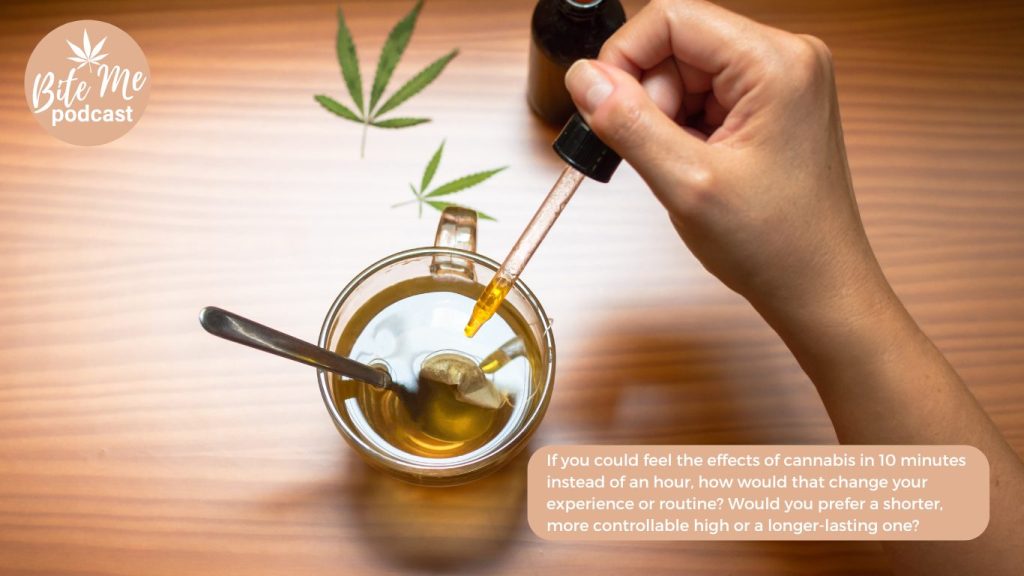
Cannabis sublinguals exist because not every moment calls for that kind of commitment. Tinctures, oral sprays, and dissolvable strips that you place under your tongue absorb directly into your bloodstream, bypassing your digestive system entirely. Effects in fifteen to twenty minutes instead of an hour or more. Duration of two to four hours instead of four to eight. Precise, repeatable dosing you can actually work with.
In this post I’m breaking down what cannabis sublinguals are, the science behind why they work the way they do, and how to make your own alcohol or glycerin-based tinctures at home. I’ll also point you to the deeper tincture-making episode on this site if you want to go further.
Your kitchen is the best dispensary you’ll ever have. Let’s talk about why sublinguals deserve a spot in it.
Listen to this epsiode:
How To Make Cannabis Tinctures – Alcohol Method
Yield: ~1 oz (30 ml)Active Prep: 15 minInfusion Time: 24 hrs to 4 weeks
Before you start: Use the Bite Me Dosage Calculator to estimate potency before your first batch. Homemade tinctures aren’t lab tested, but you can get close with basic math.
What You Need
- 3.5g cannabis flower, decarboxylated (see step 1)
- 1/3 cup (80 ml) high-proof grain alcohol (Everclear, or the highest proof you can get)
- 2 clean glass mason jars with lids
- Fine mesh sieve and cheesecloth for straining
- 1 oz dark glass dropper bottle for storage
- Labels — always label your cannabis products
Instructions
- Decarboxylate your cannabis. Preheat your oven to 240°F (115°C). Break up your flower and spread it on a parchment-lined baking sheet. Bake for 30 minutes, turning once halfway through. Let it cool completely before moving to the next step. This activates the cannabinoids. Skip this step and you’ll have a tincture with very little effect.
- Combine cannabis and alcohol. Transfer the cooled, decarbed flower into a mason jar. Pour in the alcohol until the plant material is fully submerged. Seal the jar and shake well.
- Infuse. Store in a cool, dark place. Shake the jar once a day. A 24-hour steep will pull meaningful cannabinoids. A longer steep (one to four weeks) increases potency, but also extracts more chlorophyll, which adds a green, bitter flavor. See dosing note below for context on how much this matters.
- Strain and bottle. Pour the mixture through a fine mesh sieve lined with cheesecloth into a clean jar. Squeeze every last drop out of the plant material. Transfer to your dropper bottle. Label with the date, contents, and a clear cannabis warning.
- Store correctly. Keep in a cool, dark place. A properly stored alcohol tincture will last for years.
Dosing note: Start with 1 to 2 drops under your tongue. Hold for 30 to 60 seconds before swallowing. Wait at least 30 minutes before considering more. A full dropper is approximately 1 ml. For beginners, a microdose is a good place to start regardless of what you think your tolerance is.
Glycerin Tincture Variation (Alcohol-Free)
Replace the alcohol with food-grade vegetable glycerin. The process is similar, but glycerin requires heat to extract cannabinoids effectively. Combine your decarbed flower and glycerin in a mason jar, then place the jar in a pot of water or double boiler on low heat for 2 to 4 hours, stirring occasionally. Let it cool, then strain and bottle the same way. Glycerin tinctures are sweeter, gentler, and better for anyone avoiding alcohol. They’re also slightly less potent than an alcohol extraction, and have a shorter shelf life of about one year.
What Cannabis Sublinguals Actually Are
The word sublingual just means “under the tongue.” That’s it. When you place a cannabis tincture or spray under your tongue, the cannabinoids absorb through the mucous membranes there, which are packed with tiny blood vessels sitting very close to the surface. They go directly into your bloodstream.
No digestive system. No liver. No waiting.
This bypasses what’s called the first-pass effect. When you eat an edible, your liver metabolizes the THC before it reaches your bloodstream, converting it to a more potent compound called 11-hydroxy-THC. That’s part of why edibles can hit so hard and last so long, and why they’re notoriously difficult to dose. Sublinguals skip that entire process.
The practical difference looks like this:
- Edibles: Onset 45 to 90 minutes. Duration 4 to 8 hours. Intensity can be unpredictable.
- Cannabis sublinguals: Onset 10 to 20 minutes. Duration 2 to 4 hours. More consistent and easier to gauge.
That said, there’s an important technique note. If you swallow a tincture immediately instead of holding it under your tongue for 30 to 60 seconds, you’ve just turned it into a slow-acting edible. The absorption happens through the membrane, not the stomach. Hold it there. Let it work.
Dive deeper with this post: The Science of Onset Time.
Types of Cannabis Sublinguals
Alcohol-Based Tinctures
The classic. High-proof grain alcohol is one of the most efficient solvents for extracting cannabinoids and terpenes from cannabis. The result is a full-spectrum extract that preserves the plant’s compounds. The main downside is the burn, which is real, especially at higher alcohol concentrations. If it’s too much, try diluting your dose in a small amount of water or juice rather than switching formats.
Glycerin-Based Tinctures
Food-grade vegetable glycerin is thick, sweet, and plant-based. It’s not as efficient an extractor as alcohol, but it’s much more palatable and a solid option for anyone with an alcohol sensitivity. Glycerin tinctures have come up more than once in the Bite Me Cannabis Club, and people are using them in a range of recipes and applications. I haven’t experimented with them as much as I’d like to, but they’re on the list.
MCT Oil Tinctures
Technically an infusion rather than a tincture, but many people use the terms interchangeably. MCT oil, sourced from coconut oil, works well with cannabis and has its own health profile. One listener with heart issues who can’t smoke or vape mentioned MCT as his preferred format, and it’s worth knowing the option exists. An MCT infusion works a bit differently sublingually than alcohol, since fat-based carriers are less immediately absorbed through mucous membranes, but many people use them this way with good results.
Oral Sprays and Dissolvable Strips
These are convenient and precisely dosed, which is great. They’re also harder to make at home. If you find them at your dispensary and they work for you, that’s a perfectly legitimate choice. For home cooks, tinctures are where the DIY value is.
A Little Context: Why This Episode Came From Nelson, BC
I recorded the episode this post is based on while visiting a friend in Nelson, British Columbia. It’s a small town of about 10,000 people tucked into the mountains, right on a lake, with more cannabis culture per square foot than almost anywhere I’ve been.
Nelson has its own rules. Don’t ask what people do for a living. Don’t request a basement tour. Take the back alleys if you want to get somewhere without running into someone you know and getting pulled into a conversation. These quirks are all holdovers from when a lot of people there were growing, long before the legal stores showed up.
What struck me about being there was how entirely normal cannabis is in the fabric of everyday life. No stigma. No second looks. In Ontario, where I live, there’s still a real undercurrent of judgment in a lot of circles. Nelson is a reminder of what it looks like when that’s just not a factor.
It felt like the right place to record an episode about taking control of how cannabis works in your life.
How to Make Cannabis Tinctures: Going Deeper
The recipe card above covers the fundamentals of how to make cannabis tinctures at home using the alcohol method, and the glycerin variation. If you want the full technical breakdown including the freezer method, a comparison of infusion times, potency testing experiments, and creative uses beyond sublingual application, I’ve covered all of that in detail in the Liquid Gold: The Art of Cannabis Tinctures episode. It’s a longer episode specifically built around the making and using of tinctures, and it’s worth the read or the listen.
The short version on infusion time: a 10-minute tincture will extract cannabinoids. A 24-hour tincture will nearly double the potency. Beyond 14 days, the gains are smaller and you extract more of the flavors you might not want. Start with 24 hours and calibrate from there.
Dosing Cannabis Sublinguals at Home
Homemade tinctures aren’t lab tested, which means you’re working with estimates. That’s fine. The math behind potency calculation is straightforward, and the Bite Me Dosage Calculator walks you through it. You’re looking for a benchmark, not a perfect number. Use the calculator, start with less than you think you need, and take notes.
The golden rule applies here just as much as it does with edibles: start low and go slow. For sublinguals, that means starting with 1 to 2 drops under your tongue, holding for 30 to 60 seconds, and waiting at least 30 minutes before deciding if you want more. Most dropper caps hold about 1 ml when full. For a 300 mg tincture in a 30 ml bottle, that’s 10 mg per full dropper, or about 3 mg per microdose drop. Your numbers will vary based on your flower and method, but that’s a useful frame of reference.
Keep notes. What you took, when you took it, how it felt. You think you’ll remember. You won’t. The Bite Me Dose Diary was built for exactly this, because every batch is different and your notes from the last one are the most valuable data you have for the next one.
Continue the conversation about cannabis sublinguals at Bite Me Cannabis Club.
That’s it for this week friends. Please email me any questions, comments, pictures of your creations or anything else, I love hearing from listeners! Direct messages to stayhigh@bitemepodcast.com, or the podcast hotline.
You can also support the show by subscribing, sharing episodes, leaving a review or buying me a cookie! Whatever way you choose, I’m grateful that you’re listening.
Stay high,
Margaret
Frequently Asked Questions About Cannabis Sublinguals
What’s the difference between a cannabis sublingual and an edible?
An edible is digested through your stomach and liver. A sublingual absorbs through the mucous membranes under your tongue and enters your bloodstream directly. That’s why sublinguals work faster (10 to 20 minutes vs. 45 to 90 for edibles), are easier to dose, and produce a shorter duration effect of 2 to 4 hours instead of 4 to 8.
Can I make cannabis sublinguals at home?
Yes, and they’re among the easiest cannabis products to make. The basic requirements are decarboxylated flower, a carrier liquid (high-proof alcohol, food-grade vegetable glycerin, or MCT oil), a mason jar, and something to strain with. The full recipe is in the card above. No special equipment needed.
How long should I hold a tincture under my tongue?
30 to 60 seconds at minimum. The longer you can hold it, the more the mucous membranes have time to absorb. If you swallow it immediately, you’ve converted it to a standard edible with a much longer onset time and a less predictable effect.
What’s the best alcohol for making cannabis tinctures?
High-proof food-grade grain alcohol is the gold standard. Everclear is the well-known option, though it’s harder to find in Canada. Your provincial liquor board may carry food-grade ethanol if you ask. If you can’t source either, use the highest-proof vodka you can find. Alcohol is the most efficient solvent for extracting cannabinoids, which is why most tinctures are alcohol-based.
What’s the difference between alcohol and glycerin tinctures?
Alcohol tinctures are more potent, have a longer shelf life (years when stored properly), and are faster to make. They can burn under the tongue, especially at high alcohol concentrations. Glycerin tinctures are alcohol-free, sweeter, gentler on sensitive mouths, and last about a year. They’re not quite as efficient at extracting cannabinoids as alcohol, but they’re a very solid option, especially for anyone avoiding alcohol entirely.
How do I know how strong my homemade tincture is?
You’re working with an estimate rather than a lab number, but the math is manageable. Use the Bite Me Dosage Calculator to estimate based on the weight and percentage of your flower. Then start low, go slow, and track your results over multiple sessions. Your notes become your lab report.
Can I add tinctures to food or drinks?
Yes, and this is one of the things that makes tinctures so versatile. Add a few drops to a smoothie, stir into a sauce or dressing after cooking, or drizzle over something simple. Keep in mind that once it’s swallowed rather than held under the tongue, the onset time shifts to edible territory: 45 to 90 minutes, longer duration, more metabolized by the liver. That’s not a bad thing, it’s just a different experience. Plan accordingly.
How long do cannabis sublinguals last?
The effects of a sublingually-administered tincture typically last 2 to 4 hours. If you swallow it directly or mix it into food, expect 6 to 8 hours, similar to a standard edible. As for the tincture itself in the bottle: alcohol tinctures store well for years in a cool, dark place. Glycerin tinctures are best within about a year.
Are cannabis sublinguals good for beginners?
They can be, yes. The faster and more predictable onset actually makes dosing easier than with edibles, because you’re not waiting an uncertain length of time to feel anything. That said, beginners should still start very low (1 to 2 drops), wait the full 30 minutes, and resist the urge to take more before the first dose has settled in. The start low, go slow rule exists for a reason, regardless of your experience level.
Timestamps for Cannabis Sublinguals Audio
Introduction to Bite Me Podcast & Episode Overview (00:00:06)
Margaret introduces herself, the podcast, and previews the episode’s focus on sublingual cannabis products.
Recording in Nelson, BC: Local Culture & Cannabis History (00:01:04)
Margaret shares her experience recording in Nelson, BC, discussing travel logistics, local cannabis culture, and the town’s unique history.
Nelson’s Cannabis Community & Social Norms (00:03:01)
Explores Nelson’s small-town rules, cannabis acceptance, and the evolution from illegal grows to legal dispensaries.
Personal Reflections & Nelson’s Outdoor Lifestyle (00:05:56)
Margaret describes her activities in Nelson, the area’s natural beauty, and the enduring cannabis culture.
Introduction to Sublingual Cannabis Products (00:07:00)
Introduces cannabis sublinguals as a fast-acting alternative to edibles, explaining their appeal and basic concept.
Science of Sublingual Absorption (00:08:04)
Explains how cannabis sublinguals work, the role of mucous membranes, and why effects are faster than traditional edibles.
First Pass Effect & Onset Time Comparison (00:09:14)
Details the digestive process for edibles versus sublinguals, highlighting onset time and duration differences.
Types of Sublingual Products (00:10:13)
Describes alcohol-based tinctures, glycerin tinctures, and modern sublingual sprays/strips, with pros and cons.
DIY Cannabis Tincture Basics (00:11:21)
Guides listeners through decarboxylation and the basics of making cannabis sublinguals at home.
Alcohol Tincture Method & Infusion Tips (00:12:30)
Step-by-step instructions on how to make cannabis tinctures starting with alcohol-based tinctures, including infusion times and safety notes.
Glycerin Tincture Method (00:13:24)
Instructions for making glycerin-based tinctures, emphasizing the need for heat and proper straining.
Bottling, Labeling, and Potency Considerations (00:14:23)
Covers proper storage, labeling, and the importance of estimating tincture potency of your cannabis sublinguals.
Dosing Strategies & Safe Use (00:15:19)
Discusses starting doses, sublingual administration technique, and the importance of “start low, go slow.”
Potency Calculation & Resources (00:16:21)
Mentions resources for calculating tincture potency and the value of understanding dosing math.
Benefits & Versatility of Sublinguals (00:17:24)
Summarizes the advantages of cannabis sublinguals, encourages experimentation, and hints at other uses like RSO/FECO.
Personal Plans & Final Thoughts (00:18:20)
Margaret shares her plans to make new tinctures, discusses mixing CBD/THC, and encourages listeners to try cannabis sublinguals.
Outro & Call to Action (00:19:13)
Wraps up the episode, thanks listeners, and encourages sharing the podcast.
Margaret 00:00:06 What happens when you take a love of food, a passion for culture, and a deep knowledge of cannabis and you toss them all into one bowl, you get Bite Me, the podcast that explores the intersection of food culture and cannabis helps cooks make great edibles at home. I am your host, Margaret, a certified Ganjier, a TCI certified cannabis educator, and I believe your kitchen is the best dispensary you'll ever have. Together, we'll explore the stories, the science, and the sheer joy of making safe, effective, and unforgettable edibles at home. So preheat your oven and get ready for a great episode. Let's dive in! Today we are going to be talking about the sides of sublingual. How do they work and why? And we're going to get into the nitty gritty of the science behind that. So you have a better understanding of how this particular format might work for you in your life. Now, before we get into today's episode, I just want to say I hope the audio for this one works well.
Margaret 00:01:04 Turns out okay. I am recording in Nelson, British Columbia. I'm visiting my friend and I'm actually, at the time of this recording. I'll be headed home in a couple of days, but I just wanted to get this under this recording under the belt. So I had an opportunity to do some recording. And I kind of say Nelson is a difficult place to get to. It is not easy. The closest regional airports, it's still a couple. No matter which way you go. One is a two and a half three hour drive. There is one that's a 30 minute drive, but it is nicknamed. It's called Castlegar, but it's nicknamed cancel GA because it's a small airport. And oftentimes the weather means that flights get cancelled on a regular basis. There's logistics with getting to any of those airports because there's you can't fly directly to them. You have to fly into a place like Calgary or Vancouver first. So it's been an adventure. But as my friend said when I came out to see her, she's like, you'll see why Nelson is so special and why people stay here, because it's difficult to get to.
Margaret 00:02:07 And now I can appreciate that. I had a chance to visit a couple of pot stores here, which was really fun, and we picked up some drinks. She had plenty of weed. It's interesting because Nelson is a place where historically many, many people were growing long before the cannabis stores came along. So I'm sure there's a lot of feelings about that. But my friend happens to know someone who is growing and is regularly gifted weed from that friend and other friends, because a friend with weed is a friend indeed, am I right? Which is why I should maybe make a little plug right here. Friends, if you haven't yet joined the Bite Me Cannabis Club, you can find some like minded cannabis lovers over there. It's a really lovely place, an online place that I've created for all you wonderful folks so I can have a more two way conversation with you when it comes to cannabis and all the other things that are lighting us up in our lives. So check it out you if you can learn more at join.
Margaret 00:03:01 Bite me. But of course, if you're joining us for the first time, this will be a good episode for you to get into some of the science. And if you've been listening for a while. Thank you for being here. It's because of you that I'm still doing this six years later. Can you believe it six years later? So, Nelson, as I was saying, my friend was telling me a little bit about the history of this place. She's lived here for 20 years, I believe. Originally born in Ontario, moved out to Nelson, out to BC generally a long time ago, over 20 years ago. She did come back to Ontario during the pandemic because she wanted to be close to family. While we were doing lockdowns and all that fun stuff. We don't need to talk about that time in history, but I can say that I'm grateful because if I hadn't for the fact that she came back to Ontario, I would never have met her. And it was during her time she spent about four years in Ontario that I became friends with her, and here we are.
Margaret 00:03:58 So after a time, she did move back to Nelson and has settled back into life in small town British Columbia. And even though this is a town of 10,000 people. Wow. I got to say that this town has everything. Every. This town has everything. It's right on a lake. There's mountains all around it, but it's got all the amenities you could hope for in a larger town. Except you're going to meet a lot of people on the street that you probably know. You work with your neighbors, your school, school people, all the rest of it. I have been told that there are several rules to Nelson that people abide by. One is you'd never ask what people do for a living. Of course, a holdover from when cannabis was very illegal. Two you never ask to see somebody's basement when they're giving you a house tour, because oftentimes people were growing in their basements. And three, if you come across somebody that you know in an alley, you don't stop and talk because there's a whole bunch of alleys in the downtown area from what I've been able to see.
Margaret 00:05:02 We went on a little tour of the street art and murals that exist in this town, of which there are many. They actually have like a street art festival every year, but they have like. All these beautiful murals and you get. So I saw a lot of these back alleys where some of these murals were. But the idea was that because it is a small town and if you're out on the street, you're likely to run into somebody you know, and you don't always feel like talking. You take the back alleys. That's that's the rule. So cannabis culture is alive and well. It's so interesting being in a place where so many people are cool with cannabis, because in Ontario, at least in a lot of the circles that I know, you know, there's still a lot of stigma around cannabis and that just doesn't seem to really exist here. It is so interesting. Do you have the small town that my friend has told me started out way back when, of course it was a first.
Margaret 00:05:56 First Nations land, eventually became a mining town, and then at a certain point, a lot of draft dodgers came up from the US S, and many of those folks are the ones who started growing weed, according to this very casual history that I got while we were walking around town. And here we are today. There's still a lot of logging around, of course, because there's trees everywhere in the mountains. And I think there's still there's still obviously people growing weed. But the legal weed industry has certainly changed things quite a bit. But that's a little history for you. Of my time spent in Nelson, British Columbia, we've done some hiking, we did some camping, we checked out some hot springs, which was amazing. Some of these natural hot springs are like hotter than your hot tub. It is incredible. And this is an outdoor lover's Paradise, honestly. So I'll be headed home very soon. It'll be a long, arduous journey, but it was a very worthwhile, very worthwhile to spend some time here with a dear friend.
Margaret 00:07:00 And I'm looking forward to getting back and seeing my friends and family back home. But this has been a beautiful this has been beautiful. Thanks for sharing it with me, friends. Have you ever wished you could get the predictable, controlled effects of an edible without that long, sometimes unpredictable? Wait, and if you've listened to the episode on onset times, you will know what I'm talking about. There are many factors that can influence how an edible takes effect. And if you haven't listened to that episode yet, the signs of onset times, you may want to check that one out as well. But you know that feeling when you're eating a brownie, and then you're wondering for the next hour or so when it's going to kick in? What if you could feel the effects in 15 minutes instead of an hour? Well, today we're going to talk about that. Exactly. We're stepping outside the kitchen to explore fascinating and fast acting alternative to traditional edibles. Sublingual. It's a fancy word, but the concept is simple and incredibly useful for any home cannabis cook.
Margaret 00:08:04 We'll get into what they are, the science that makes them work so fast, and of course, how you can make your own at home. Because would it really be bite me if we weren't experimenting in the kitchen like the mad hatters that we all are? So what exactly is is a sublingual? The name itself, sublingual, literally means under the tongue. And that's precisely where the magic happens. We're talking about the products like tinctures, which are the little dropper bottles of cannabis infused liquids, as well as oral sprays and even thin, disposable strips. And unlike an edible that you chew and swallow, you administer a sublingual by placing it under your tongue and letting it absorb directly into your body. The reason this method is so different and so much faster, comes down to the unique environment inside your mouth. The area under your tongue is filled with mucous membranes that are packed with tiny blood vessels, blood vessels, or capillaries sitting very close to the surface. And when you place a cannabis tincture there, the cannabinoids like the THC, the CBD can pass right through those thin membranes and enter directly into your bloodstream.
Margaret 00:09:14 This is a total game changer because it completely bypasses what's known as the first pass effect. When you eat an edible, it has to travel all the way through the digestive system and then to your liver. Your liver metabolizes the THC, converting it into a more potent but slower acting compound. And this journey is why the edible can take so long to kick in. And it's also where a lot of the original potency can be lost. I also did an episode on this, which I think was inventively entitled The Science of Edibles, which you can check out when I get more into that first pass metabolism. First pass effect on how edibles work in your digestive system. Now with sublingual, as you skip that whole digestive tour, the cannabinoids get a direct express ticket into your system. This means that you'll start to feel the effects in as little as 10 to 20 minutes, which is a world away from an hour or more that you might have to wait after you're eating an edible. The trade off is that the effects aren't going to last quite as long.
Margaret 00:10:13 Usually around 2 to 4 hours versus the 4 to 8 you might get from a standard edible, but for many people, that faster onset and shorter duration means more control, which is always our goal here. Now if you walk into a dispensary, you'll see a few different kinds of sublingual, and they're normally defined by what the cannabis infused into the most classic and common form is an alcohol based tincture. These have been around for centuries as a way to make herbal medicines. They typically use a very high proof food grade grain alcohol, because it's an incredibly effective solvent for pulling out all those valuable cannabinoids and terpenes out of the plant. The main downside for some is the strong, burning taste of alcohol. For those who want to avoid alcohol, there's also a wonderful alternative glycerin tinctures. They use a food grade vegetable, glycerin, which is a thick, sweet, plant based liquid. It's not quite as efficient as an extraction as compared to alcohol, but it's much more palatable and perfect for anyone with an alcohol sensitivity or those avoiding alcohol completely.
Margaret 00:11:21 And of course, technology has given us modern marvels like precisely metered sublingual sublingual sprays and little dissolvable strips that look like breath strips. And they offer incredible convenience and dosing accuracy. But they are much more complex to create at home. So for our purposes, tinctures are where the DIY magic is at. And as you know, here at Bite Me, we're all about empowering you, the home cook. You absolutely do not need a high tech lab to create your own effective and reliable cannabis tinctures. So let's walk through a simple foundational recipe. First things first. As you've heard me say a million times, decarboxylation is key. You have to activate your cannabis, and you do this by gently heating your flour in the oven. I like to go with about 240°F for about 30 minutes. And if you need a refresher on that, you can check out the website or listen back to the episodes that I've done on decarboxylation. I'll link to those in the show notes. Once your cannabis is discharged, you have your two main pathways for your infusion for the alcohol method.
Margaret 00:12:30 You'll combine your cannabis with a high proof grain alcohol in a mason jar. Make sure the alcohol completely covers the flour, and then you seal it up and store it in a cool, dark place. The traditional method is to let it sit for several weeks, giving it a good shake every day. But if you're impatient like me, you can speed up this process by creating a warm water bath in a crock pot or a double broiler and letting it infuse over a few hours on very low heat. Never use direct heat with alcohol. I hope this goes without saying. And of course I have done some experimenting when I interviewed Vanessa Alvarado on the podcast. We talked about shortening infusion times. This also applies to alcohol. You don't necessarily have to keep it in the cool, dark place forever. You will still extract cannabinoids if you do it for 30 minutes, giving it a shake every ten minutes or so, or. I found in my own experiments I would have to go back and look to see what she found with her experimentation.
Margaret 00:13:24 But I did get more a significant more amount. I shouldn't say significant. I have to look back at my notes and they're not handy at the moment. But I did get more cannabinoids pulled out of the plant material when I let it sit for 24 hours, so you don't necessarily have to leave it sitting for weeks to get that. To get some of the cannabinoids pulled out for the alcohol method. So keep that in mind. You don't necessarily need to heat it up, though that can help. For the glycerin method, the process is similar, but it really does. It really does require heat. You'll combine your flour and a food grade glycerin in a jar, and the place that jar in a pot with water or in a double broiler, and you can infuse it on low, gentle heat for a few hours, stirring or shaking occasionally. You want to give the glycerine plenty of time to absorb all those cannabinoids, and after your infusion is complete, you let it cool and then straight out all that plant material.
Margaret 00:14:23 I recommend using like, a fine mesh sieve. And then if you have a little cheesecloth as well for a second strain, that can help get it really clean. And that's it. You've made your tincture. All that's left is to pour into a dark glass dropper bottle for easy dosing and storage. Make sure you label it clearly with the date, the ingredients, and a big warning that it's a cannabis product. Of course you know me. Label label label. And one quick note on potency. It can be tricky to get the exact strength of your homemade tinctures without lab equipment. And that's the next, And that is why our next topic dosing, is so critical. Critical. And that's why our next topic, dosing, is so critical. The golden rule of edibles applies just as much to tinctures. Start low and go slow. And I can't stress this enough. I know if you've been listening to the show for any length of time, you know, I mention this all the time We're talking about 1 or 2 single drops to start.
Margaret 00:15:19 Not a full dropper. And this technique is just as important as the dose. You want to place the drops under your tongue and hold them there for at least 30 to 60s before you swallow. And this gives those mucous membranes time to absorb the cannabinoids. If you swallow it immediately, you're just turning it into a slow acting edible. So the thing here, this is when you notice that the alcohol tincture can be quite leave a burning sensation under your tongue. But that's just the cost of doing business. So you're going to wait at least the longer you can hold it under your tongue, the better. Wait at least 30 minutes to see how you feel before considering taking more. In fact, I'd probably give it even longer than that, and you'll quickly learn what the right dose is for you, giving you a level of control that's hard to achieve with other methods. And of course, you can calculate, even though it is a little more difficult and maybe not quite as accurate as lab testing, you can calculate the potency of your Tinctures using basic math, and I did a whole episode on that as well.
Margaret 00:16:21 And if you check that out, I have a handy dosing potency document that you can access to figure it out. I have a dosing calculator on my website as well, but sometimes it's really smart to know how to do the math that's behind some of these calculators that you'll see online. It's pretty easy to do once you know how to do it. It's some pretty basic math, but I do recommend that you figure out the potency of your of your tinctures, of course, because then otherwise, how do you know how much it is that you're taking? Starting low and going slow doesn't mean a whole lot like what's two drops if you have no idea how potent it is, am I right? Right. So I'll link to that in the show notes as well, so you can check that out for when you go to make your own tinctures. And there you have it. Sublingual oils are a fantastic tool for any cannabis users toolkit, offering a fast acting, discreet and highly controllable experience. Whether you choose an alcohol or glycerin base, making your own tinctures is simple and rewarding, and that puts all the powers right in your hands where we want it.
Margaret 00:17:24 So thank you for tuning in to bite me. I hope you feel empowered to explore the science of something lingual. Now that I've done this episode, I don't think I have any sublingual or tinctures in my pantry at the moment. And that is, oh, I do have one in the freezer that I've kind of forgotten about, which I probably need to deal with when I get back from Nelson, British Columbia. But I haven't actually experimented with glycerin at all yet. I know some people that have that has come up actually several times in the Bite Me Cannabis Club, people talking about their glycerin tinctures and how they're using them, because tinctures can also be great to use in certain types of edibles as well. And of course, you can go on to make things like Rick Simpson oil or Fico as well. So it sort of opens up a whole new world of possibilities. But I think I'm going to be making some new tinctures when I go home, especially for me, the CBD, something I can do, actually, I see the value in having both.
Margaret 00:18:20 I like having CBD and THC tinkers and then you can always mix them as well. Like if you have two separate ones. I mean you can always use a ratio cannabis as well, but if you have two separate tinctures you can always mix them to a little, a little. Choose your own adventure if you will. So I'm inspired now to create some new tinctures, because I haven't done it in a little bit, and it is a great way to get your medicine easily and discreetly without having to roll joints or go outside. And I know many of you myself well, actually, I don't really smoke joints very much, but I know many of you love the ritual of joints. Tinctures can really answer the call. So thanks for tuning in my friends. If you enjoyed this episode, please share it with somebody that you also think would enjoy it. Because sharing is caring and really helps spread the word of their show. And word of mouth is probably the best way to tell the world about Bite Me, the show about edibles.
Margaret 00:19:13 And that's it for this week, my friends. I'm your host, Margaret. And until next time, stay high.
Sign up to receive email updates
Enter your name and email address below and I'll send you periodic updates about the podcast.

Margaret,
I enjoy your Podcast! Thanks for sharing with us.
Btw, I’m 70 years old, and have been using cannabis since I was 15. Recently I had some heart issues, and although my dr said cannabis is ok to use, smoking and vaping are not.
I’ve been making edibles for years, and also using sublinguals. I don’t use alcohol anymore so that’s no go. I tried glycerin and hated the sweetness. I currently use MCT oil for my tinctures, and because it is sourced from coconut oil, it works very well with cannabis. MCT oils also have additional health benefits.
Have you tried using MCT oil for your tinctures?
Thanks again for your Podcast!
Hi John, thanks for the comment and the kind words. Yes I have used MCT oil in the past and it’s another great option for infusion cannabis. Tinctures are often categorized as alcohol or glycerine while the MCT oil would be categorized as an infusion. But at the end of the day, it’s whatever works best for an individual! It sounds as though you’ve done quite a bit of experimentation to find what you find is most helpful, thanks for sharing!