Navigating Cannabis Culture, Policy, and Community: Lessons from Australia and Canada with Paul O’Donoghue
Welcome friends and fellow cannabis enthusiasts! In this episode, I had the pleasure of sitting down with Paul O’Donoghue, host of the Give and Toke podcast, for a deep dive into the evolving cannabis landscapes of Australia and Canada. Paul’s journey from a curious teenager in Australia to a budtender in Vancouver, BC and now a leading voice in Australian cannabis media, offers a treasure trove of insights for anyone passionate about cannabis.

In this post, I’ll break down the main themes and actionable takeaways from our conversation, offering you a comprehensive guide to understanding the nuances of cannabis culture, policy, and community on both sides of the globe. Let’s get into friends!
Listen to this episode:
Paul’s Cannabis Journey: From Stigma to Advocacy
Paul’s story is a familiar one for many: a first encounter with cannabis as a teenager, followed by years of navigating stigma, secrecy, and self-discovery. What sets Paul apart is his willingness to reflect on how his relationship with cannabis has evolved, from casual experimentation to intentional, medicinal use.
Key Takeaways:
Embrace Evolution: Your relationship with cannabis will change over time. What worked for you at 20 may not serve you at 35. Be open to adjusting your consumption habits, products, and intentions.
Mindful Consumption: Paul now tracks every product he tries in a Google doc, noting effects and discussing them with his doctor. This level of self-awareness is crucial, especially as tolerance and needs shift with age.
Shed the Stigma: Moving to Canada allowed Paul to experience cannabis without fear of judgment. Seek out communities, either online or in person, where you can be open about your use and learn from others.
Try the Bite Me Cannabis Club for a supportive private community.
Comparing Cannabis Landscapes: Canada vs. Australia
Paul’s unique perspective as someone who has lived and worked in both countries offers a rare window into the contrasts and commonalities between the Canadian and Australian cannabis scenes.
Canada: The Land of Legalization
In Canada, federal legalization has made cannabis widely accessible, with polished retail environments and knowledgeable staff. The transition from legacy to legal markets was rocky as quality and pricing issues led many to stick with legacy growers. Corporate cannabis is a reality, but craft producers and legacy players continue to innovate and push for quality.
Australia: Conservative, Fragmented, and Evolving
Meanwhile in Australia, medicinal cannabis is legal but tightly regulated, with significant barriers to access and a patchwork of state laws. Stigma remains strong, and the market is fragmented between medical, naturopathic, and recreational advocates. Roadside drug testing laws are punitive, measuring THC presence rather than impairment, creating fear and confusion for patients.
Actionable Insights:
If you’re in a restrictive market, advocate for sensible reform and connect with others to share resources and support. In legal markets, support craft and legacy producers who prioritize quality and innovation.
Building a Cannabis Platform: The Origins and Evolution of Give and Toke
Give and Toke began as an Instagram review page, born out of Paul’s desire to help customers navigate the confusing early days of Canadian legalization. It quickly grew into a podcast and educational platform, filling a critical gap in the Australian cannabis conversation.
What Makes a Great Cannabis Platform?
Focus on Education, Not Ego: Paul’s goal is to amplify voices, not be the loudest in the room. The best platforms are those that serve the community, not personal fame.
Consistency and Authenticity: Podcasting is a marathon, not a sprint. Real-life demands can make consistency tough, but meaningful feedback and community engagement keep the fire burning.
Value-Driven Products: Paul’s merchandise like lockable, smell-proof bags and practical accessories, are designed to add real value, not just cash in on a trend.
Tips for Aspiring Cannabis Content Creators:
- Start with a clear purpose: What gap are you filling? Who are you serving?
- Be transparent about your journey, people connect with authenticity.
- Collaborate with others in the space to amplify your impact.
Lessons from the Frontlines: Humility, Education, and Community
One of Paul’s most profound insights is the importance of humility in the cannabis space. The more you learn, the more you realize how much you don’t know. This is especially true in an industry rife with misinformation and evolving science.
Key Lessons:
Stay Curious: Whether you’re a patient, a grower, or an advocate, never stop learning. The science of cannabis is still in its infancy.
Listen to Diverse Voices: Paul’s guests range from doctors to cultivators to policymakers. Each brings a unique perspective that enriches the conversation.
Foster Community: Cannabis users come from all walks of life. Breaking down stereotypes and building inclusive communities is essential for progress.
Navigating Legalization: Corporate vs. Craft Cannabis
The tension between corporate cannabis and legacy/craft producers is a recurring theme in both Canada and Australia. Paul advocates for mutual respect and collaboration, recognizing the value each brings to the table.
Nuanced Insights:
Corporate cannabis brings funding, scale, and legitimacy, but can lose sight of quality and innovation.
Craft and legacy growers are the heart and soul of the industry, often producing superior products and driving experimentation. Regulatory and financial barriers make it hard for new entrants, especially passionate small-scale operators, to break in.
Actionable Advice:
As a consumer, vote with your wallet. Support craft and legacy brands when possible.
If you’re a producer, find ways to differentiate, focus on quality, unique genetics, and direct-to-consumer relationships. Advocate for policies that lower barriers to entry and protect small businesses.
The Medical Cannabis Maze: Standardization, Access, and Patient Experience
Australia’s medicinal cannabis system is both a blessing and a challenge. While it offers legitimacy and patient-doctor relationships, it struggles with the inherent variability of cannabis as a plant medicine.
Key Points:
Standardization vs. Individualization: Unlike pharmaceuticals, cannabis flower varies from batch to batch. Patients and providers must embrace this variability and focus on what works for the individual.
Regulatory Fragmentation: State-by-state differences create confusion and barriers. For example, some states allow product substitution, others don’t.
Stigma in Healthcare: Many doctors and pharmacists remain skeptical, sometimes dismissing the importance of strains and terpenes.
Expert Recommendations:
- Track your own experiences and share them with your healthcare provider.
- Seek out cannabis-literate doctors and pharmacists who respect patient experience.
- Advocate for regulatory harmonization and education within the medical community.
Harm Reduction, Stigma, and the Future of Cannabis
Paul is a passionate advocate for harm reduction and destigmatization. He points out the irony of Australia’s strict cannabis laws while alcohol remains widely accepted, despite its well-documented harms.
Key Insights:
- Restrictive laws don’t stop use, they drive consumers to unsafe, unregulated markets.
- Harm reduction means making safe, affordable, and high-quality cannabis accessible to all, not just those with connections.
- Breaking down stigma requires open conversation, education, and cultural shifts, like the small but meaningful gestures Paul experienced in Canada (e.g., servers holding tables for cannabis consumers).
Pair this with these episodes: Cali Sober with Amanda Reiman and The Ultimate Guide to Consumption
Actionable Tips for Cannabis Consumers and Advocates
Be Intentional with Your Consumption
- Track your products and effects. Use a journal (Bite Me Edibles Journal is a great choice) or digital document to note what works and what doesn’t.
- Regularly check in with your healthcare provider, especially if you’re using cannabis medicinally.
- Adjust your regimen as your needs and tolerance change.
Support the Community
- Buy from craft and legacy producers when possible.
- Share your experiences and knowledge with others either online or in person.
- Get involved in advocacy efforts, whether it’s contacting lawmakers or supporting reform organizations.
Educate Yourself and Others
- Stay up to date on the latest science, policy changes, and product innovations.
- Listen to diverse voices, podcasts like Give and Toke and Bite Me are great places to start!
- Challenge stereotypes and misinformation when you encounter them.
Advocate for Sensible Policy
- Push for laws that measure impairment, not just presence, especially around driving.
- Support regulatory frameworks that balance access, quality, and safety.
- Encourage collaboration between corporate, craft, and legacy sectors.
Embrace Harm Reduction
- Choose safe, tested products whenever possible.
- Advocate for policies that prioritize public health over prohibition.
- Share harm reduction resources with your community.
Final Thoughts: Staying Curious, Staying High
My conversation with Paul O’Donoghue of Give and Toke was a reminder that cannabis is more than a plant, it’s a culture, a community, and a catalyst for change. Whether you’re in Australia, Canada, or anywhere in between, the journey toward sensible cannabis policy and acceptance is ongoing. By staying curious, supporting each other, and advocating for harm reduction and education, we can help shape a future where cannabis is accessible, respected, and celebrated.
That’s it for this week friends. Please email me any questions, comments, pictures of your creations or anything else, I love hearing from listeners! Direct messages to stayhigh@bitemepodcast.com, or leave a voice message on the podcast hotline.
You can also support the show by subscribing, sharing episodes, leaving a review or buying me a cookie! Whatever way you choose, I’m grateful that you’re listening.
Stay high,
Margaret
FAQ For Paul O’Donoghue Interview On Bite Me Podcast
Who is Paul O’Donoghue?
Paul O’Donoghue is the host of the “Give and Toke” podcast, based in Australia. He is recognized as a voice of authority on the cannabis landscape in Australia and has interviewed a wide range of experts in the field.
What is the “Give and Toke” Podcast?
“Give and Toke” is a podcast that explores cannabis culture, featuring conversations with industry experts, medical professionals, policymakers, and cannabis users from around the world.
What are the Main Topics Discussed in This Episode?
- Comparison of cannabis landscapes in Canada and Australia.
- Paul O’Donoghue’s personal cannabis journey and how it has evolved over the years.
- Insights into cannabis advocacy, culture, and the intersection of cannabis with food and lifestyle.
Why Should Listeners Tune In?
Listeners will gain valuable insights into the cannabis industry, advocacy efforts, and cultural perspectives from both Canada and Australia. The episode also offers practical advice and engaging stories from Paul’s experiences.
How Can Listeners Engage with “Give and Toke”?
While the transcript doesn’t specify engagement methods, listeners can typically follow podcasts on platforms like Apple Podcasts, Spotify, or the podcast’s official website for updates and community discussions.
What Makes This Episode Unique?
This episode provides a cross-country perspective on cannabis legalization, culture, and advocacy, making it a must-listen for anyone interested in the global cannabis movement.
Timestamps
Introduction & Episode Overview (00:00:05)
Margaret introduces the podcast, episode, and guest Paul O’Donoghue, outlining the topics to be discussed.
Paul’s Cannabis Journey: From Australia to Canada (00:02:20)
Paul shares his first experiences with cannabis, the impact of moving to Canada, and how his perspective evolved.
Starting the Give and Toke Podcast (00:06:46)
Paul explains the origins of his podcast, beginning as an Instagram review page and evolving into a platform for cannabis stories.
Podcasting, Community, and Canadian Guests (00:11:18)
Discussion about the value of podcasting, learning from guests, and the influence of Canadian cannabis culture.
Most Surprising Lessons from Podcasting (00:12:26)
Paul reflects on humility in the cannabis space, the need for political activism, and challenges in Australia’s cannabis laws.
Comparing Cannabis Legalization: Canada vs. Australia (00:18:09)
Exploring the slow pace of change in Canada, differences in regulations, and the lack of cannabis lounges.
Early Days of Legalization in British Columbia (00:19:23)
Paul describes the transition from legacy to legal markets in Vancouver and the impact on local culture.
Corporate Cannabis vs. Craft Producers (00:26:42)
Debate on the future of small growers, the rise of corporate cannabis, and the importance of innovation from craft producers.
Pinch-Me Moments & Personal Highlights in Canada (00:32:20)
Paul shares memorable experiences working in Canada’s cannabis industry and the legitimacy it brought to his advocacy.
Returning to Australia: Culture Shock & Medical System (00:36:03)
Paul discusses the differences upon returning to Australia, the focus on medical cannabis, and challenges with stigma.
Australia’s Medical Cannabis System & Its Challenges (00:45:05)
Analysis of Australia’s cautious, medical-focused approach, its strengths, and the drawbacks of fitting cannabis into pharmaceutical models.
Legal Barriers: Driving Laws & Patient Discrimination (00:50:46)
Paul highlights the impact of strict driving laws on patients and the need for legal reforms to reduce discrimination.
Alcohol vs. Cannabis: Social Norms & Stigma (00:54:39)
Discussion on alcohol’s dominance in social settings, stigma around not drinking, and the desire for more cannabis-friendly options.
Looking Forward: Give and Toke’s Future (00:58:06)
Paul outlines upcoming plans for his podcast, merchandise, and expanding the brand’s value to the community.
Closing Remarks & Mutual Appreciation (01:02:23)
Margaret and Paul express gratitude, discuss future collaborations, and wrap up the episode.
Margaret 00:00:05 What happens when you take a love of food, a passion for culture, and a deep knowledge of cannabis and you toss them all into one bowl? You get Bite me! The podcast that explores the intersection of food, culture and cannabis and helps cooks make great edibles at home along the way. I am your host, Margaret, a certified Ganjier TCA Certified Cannabis Educator, and I believe your kitchen is the best dispensary you'll ever have. Together, we'll explore the stories, the science, and the sheer joy of making safe, effective, and unforgettable edibles at home. So pre-heat your oven and get ready for a great episode. Let's dive in! Today is episode 331, where I sit down with Paul O'Donohue, host of the Give and Talk podcast. Paul is based in Australia, and he has become the voice of authority when it comes to the cannabis landscape there. Not only has he had the opportunity to interview industry experts, medical professionals, policymakers, and cannabis users from around the world. He spent some time working in Canada and a retail dispensary.
Margaret 00:01:09 Not long after legalization, we compare and contrast the cannabis landscapes in Canada and Australia. The similarities and the things that make them different. Aside from some of the obvious things, his own cannabis journey and how it's changed over the years, and the single best line I've heard for telling people that you're not drinking anymore. I know you're going to love this interview, so please enjoy this lively conversation with Paul O'Donohue.
Margaret 00:01:39 All right, we are live, and I am very thrilled to be joined today by Paul O'Donohue. And Paul is the host of a podcast called Give and Toke, which I love the name of that of that show. I wish I'd been as clever as you were, but I think it's fantastic and I'm really thankful that you are able to join me today. and so let's get right into it. Paul, as I just mentioned, you've created a platform in Australia and it's a key voice in Australia. Cannabis conversations. Could you share a little bit about your personal why and what first are you into the world of cannabis, and also what inspired you to start a podcast like Give and Talk?
Paul O'Donohue 00:02:20 Thank you.
Paul O'Donohue 00:02:20 And firstly, I want to say what a pleasure is to be here. You know, I always enjoy, joining forces with fellow podcasters. I think so often we're on the other side of the mic like you are right now, asking the questions, and it's kind of a strange, rare experience to be asked a question myself. So I just want to say thank you for having me. Big fan of the show. And I've got such a soft spot for Canada having, you know, cut my teeth there. So really pleased to be here and sharing my story. If I were to go back to kind of the start of my cannabis experience, I would say it started experimental, but kind of became supplemental. I actually still really remember the first time I consume cannabis and the effect that it had on me. It wasn't a particularly, you know, glamorous evening or event. You know, an older friend of mine, you know, was driving me to a gig show me in his glove box.
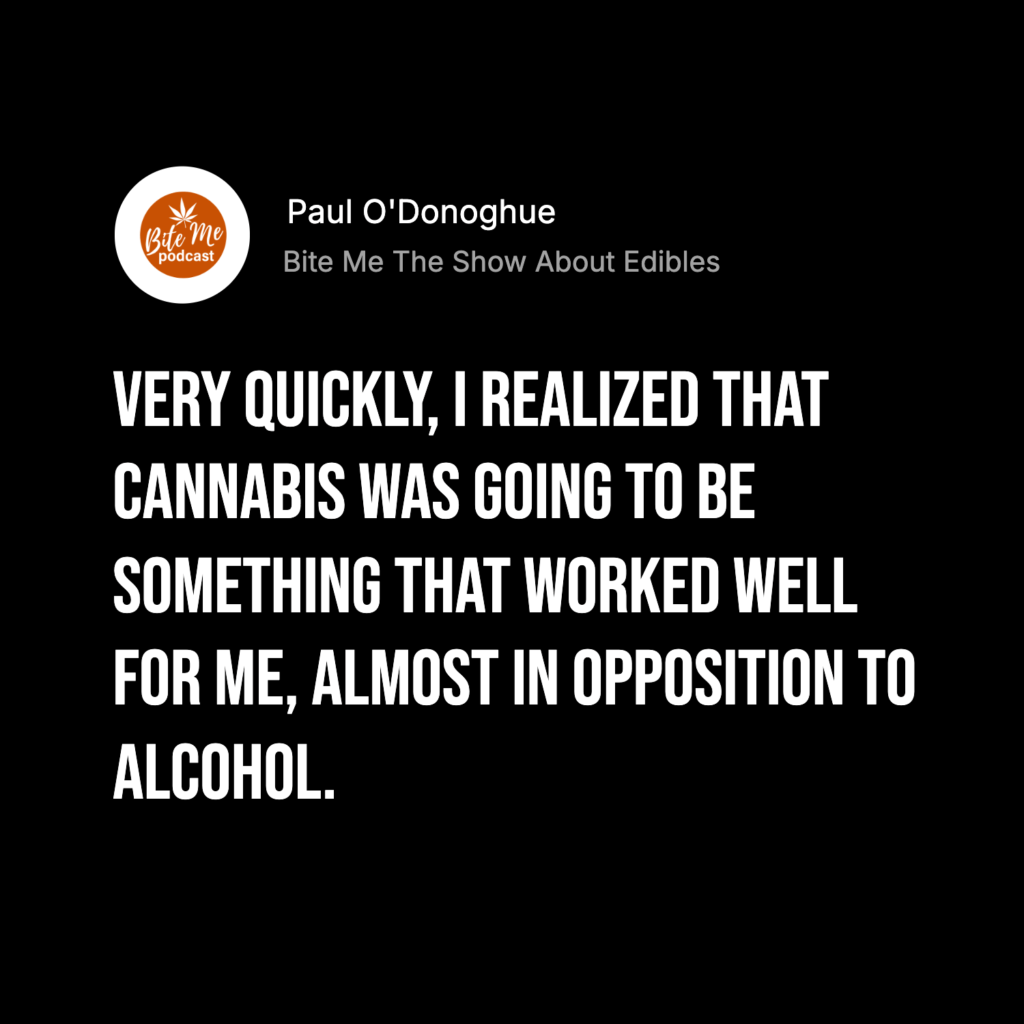
Paul O'Donohue 00:03:08 He had a little bit of cannabis on him, and we ended that night in a cul de sac with, you know, 4 or 5 people. I'm 16, 17. You know, there's there's cool girls there, there's cool guys there. And it was, you know, a pretty run of the mill experience. But it was a really lovely one. Like, I kind of remember the effect going, You know, I've been drinking like most Australian teenagers do, for a couple of years. you know, to excess, unfortunately, I must confess. And so it was really nice to try this thing that went. This is kind of calming me down. This is making me a little bit more relaxed. This is making me laugh in a way that I haven't. So from a personal level, very quickly I realized that it was going to be something that worked well for me, almost in opposition to alcohol. It was like, you know, kind of the, the, the sunrays appeared.
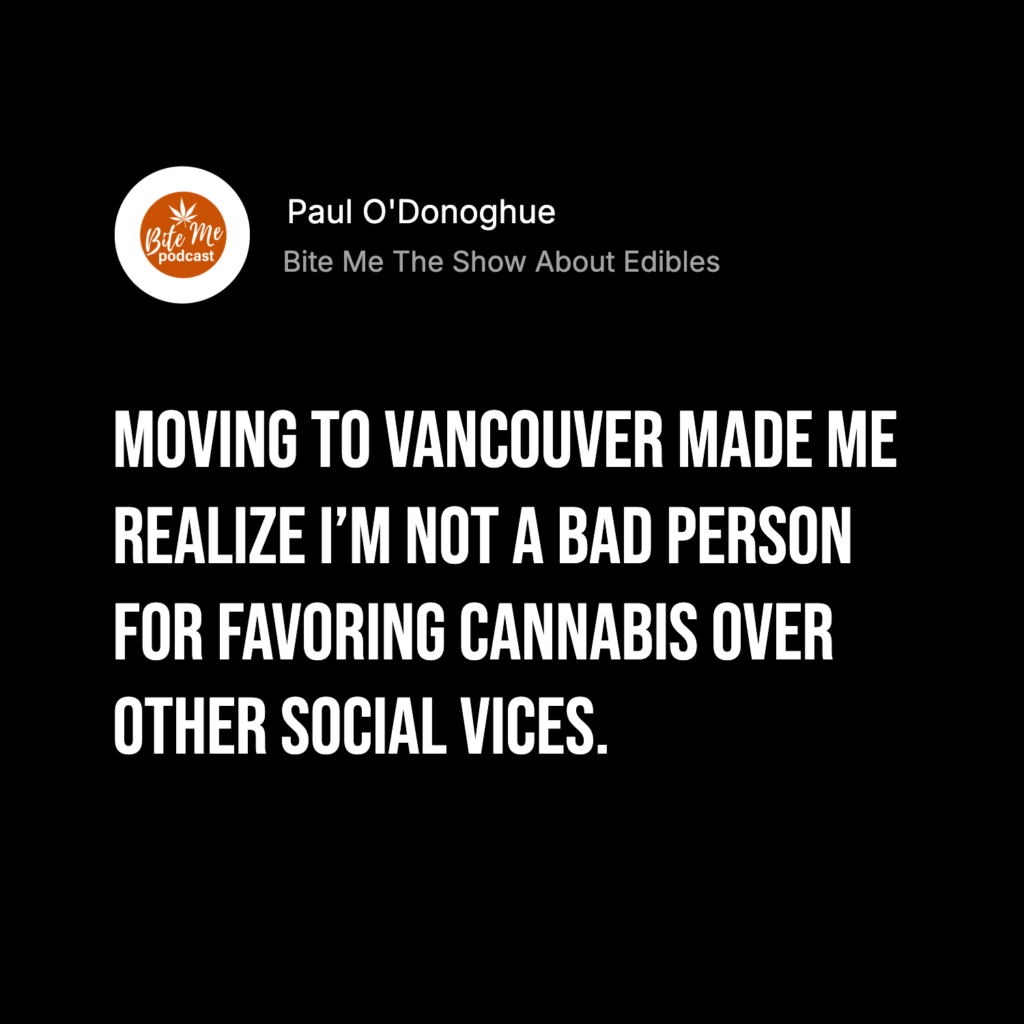
Paul O'Donohue 00:03:53 I went, this might be something for me. There was then, you know, kind of a ten years of experimentation trying to find where it fits in your life, dealing with stigmas and not consuming it as much as I would like to. And it was my move to British Columbia that made me realize that, hey, you know, I'm not the worst guy in the world for liking this. I'm not a bad person for favoring it over other social vices. And so I moved to Vancouver in 2019. I had the privilege of working for a company that very quickly moved from the liquor space to the cannabis space, and they sent me to a cannabis cannabis sommelier course at University of British Columbia. And that day changed everything for me. That made me realize the therapeutic potential that could be espoused to people. You know, it's no longer just like, oh, I like this thing. It's how can I share this with others? How can I share this science? How can I talk about terpenes and files and esters and things like that as a way to, to break through the stoner stereotypes? So I think I would sum it up as two really distinct times, you know, when I was kind of 16 or 17.
Paul O'Donohue 00:04:56 That first experience, you know, while I'm not here promoting underage use, it wasn't certainly wasn't the end of the world in a responsible environment. And then in my late 20s, kind of coming to Vancouver feeling that, I'll be honest, 30 years of social progression of drug reform and drug law ahead of Australia. you know, it was it was even a big thing for me to not fuck out my joint in an alleyway when I saw a car coming down. because I was so used to Australia being like, someone's going to tell me off, someone's going to tell me, that stinks. So I've got to thank, you know, that that friend that gave me my first experience and that lovely Australian evening in a cul de sac right through to my experience. you know, counter wraps being the catalyst and planting that seed for, like, a true understanding of what cannabis can bring beyond just the social. So, yeah, like I said, kind of supplemental, I'm sorry, experimental into supplemental.
Paul O'Donohue 00:05:51 It's now a hugely important part of my life for maintaining homeostasis, maintaining balance. And I feel, you know, being a functional, contributing member of society.
Margaret 00:06:01 Yeah, absolutely. I mean, I just love that answer, honestly, because it sounds like that culmination that happened in Canada is a really nice link between you and I because you arrived in Canada. Just it sounds like a year after legalization here, which is kind of like great timing.
Paul O'Donohue 00:06:17 Yes, three months after. So legalization is actually my wife's birthday. and yeah, so it was it was two months later. So it was really right at the, the coalface, if you will. Like, I didn't get to see day one, but it felt really close to it.
Margaret 00:06:32 Well I mean two months. That's pretty pretty close. I mean, they didn't even have legal edibles at that point in time. So you were there right at the very beginning now? Yeah. You've obviously been a cannabis consumer for most of your adult life.
Margaret 00:06:46 Why did you start a podcast?
Paul O'Donohue 00:06:49 Yeah. So it goes a little bit before that. And given toke was started purely as an Instagram review page. Being there at the, you know, the start of legalization, it was really just a gap to fill for my customers as a bud tender. So knowing that the Vancouver's beautiful municipal legalization was wiped out by federal, you know, there were no more small jars. There was no way to look at your cannabis. And let's be honest, the market was flooded initially by really low quality products that, you know, the the supply chain hadn't been worked out, the time to consumer hadn't been worked out. And so people were buying these, you know, $20 brands that were packaged like a four pack of beer that were pretty subpar quality. You know, they were super dry. They didn't have that kind of attention to detail that people expect from Canadian and BC Bud. And so I just was like, I've got to start something that shows people what it looks like that has my description, you know, as best as I can about what the flavors and the rumors and the effects might be.
Paul O'Donohue 00:07:47 And so it was just a handy tool for the customers in the store, and they really appreciated that. I then, you know, obviously had my two amazing years in Canada, which we'll discuss in a little bit more detail, but ultimately was coming home to Australia and realizing how immature our market was, how cannabis naive people in general are. You know, there's a lot of passion here and a lot of people who want to make change and tell the true story of legacy growers and things like that. But we are you know, I alluded to alluded to it already. We are devastatingly behind Canada in, you know, sensible drug policy. so I came back and went, I've learnt all this stuff, I've seen all these things. I've consumed some incredible cannabis. I need to share these stories. You know, the people that I've met, the sacrifices that are made for people to participate consistently in this space, I think are huge. So I was like, I almost I couldn't come home and not tell that I couldn't come home and just be a school teacher again.
Paul O'Donohue 00:08:46 I needed to have something on the side that just started to tell the story. So the Give and Take podcast started initially. You know, the first half dozen episodes were Canadian stories where relationships are built in Canada, telling the story of what people had been through to get to that stage of either working for a legal cannabis company or advocating for change in the craft space or things like that. And that's ultimately what got the ball rolling on give and take. Having its greatest impact here in Australia was first sharing Canadian stories, then the podcast being a catalyst for relationships with people in our local industry. You know, members of Parliament, you know, senators, CEOs, doctors, lawyers, pharmacists, like some of the big movers and shakers. So again, much like the Instagram was a gap to fill in Vancouver when I was a bartender. The podcast, I believe, you know, tells the stories and fills a gap here in the market that lets people know, you know, just how much people are putting at stake to, you know, to evangelize cannabis, to share the therapeutic benefits, to help people in a true medicinal way.
Paul O'Donohue 00:09:50 You know, as we've already discussed ahead of this show, Australia does have a rather rigid medicinal framework as opposed to Canada. so it's about preserving that legitimacy. So, you know, it's always been about filling a need. It's not about me. I'm really proud to do the work that I do, and I'm proud to, you know, when I run into people and they're like, oh, you're Paul from Give and Take. I listen to the podcast. two years ago at my wedding, whilst doing my wedding speech, the bartender went up to one of my friends and went, I know that voice from somewhere. And so that you know that. Yeah, that was really profound for me. Like, those are the little things that make this worthwhile. I'm sure you can speak to this too. Podcasting is a labor of love. You know, remaining consistent can be a challenge. You know, real life and work can get in the way, and you worry about the end product that's coming out.
Paul O'Donohue 00:10:36 but just to know that it is impacting people, and people listen and people care means the absolute world to me. And even last year, when I moved from being a primary school teacher, to this year being a primary school teacher to being in the industry full time. The amount of people that reached out, you're still doing the podcast, so you still do. The podcast tells me that it's worth doing. So I always just try. Yeah, yeah. So yeah, always just trying to fill a need, you know, trying to add value to people. I'm not going to deny that. It hasn't helped me, you know, boost my reputation, even potentially helped me get the job in the industry. But I'll always go back to the fact that, you know, people, people enjoy the show. People get something out of it. And as long as that's the case, I'll continue to do it.
Margaret 00:11:18 Yeah, maybe it'll help you get a job in the industry. But that's not without putting in a lot of hard work to get to that spot, to be able to get that job because of the podcast.
Margaret 00:11:26 So I recognize that as well. And I would say having guests on my show is one of my favorite things to do, because that's when I really learn so much from other people. And I know you're still telling Canadian stories because I listen to an episode not that long ago. Or you. I can't remember the fellow's name. I'm sorry, but he was a, I believe, a grower from Canada.
Paul O'Donohue 00:11:45 yes. Angus. So, yeah. Australian grower in Canada that's now bought brought these lessons back home. Yeah.
Margaret 00:11:52 Yeah.
Paul O'Donohue 00:11:52 And that right there is proof in the pudding. You know we've we've got Canada has had has got an opportunity to be such an influence on the world's markets. And you know little side tangent here. But I think that's also not to be taken for granted to, you know, the influence that Canada has. As you know Australia and Canada get compared is pretty like countries from time to time. You are bigger than us in population and I think potentially bigger in size though we're both in massive, massive countries.
Paul O'Donohue 00:12:18 I think it's really cool to see the impact that we can share, the knowledge we can share, and I think the right people know that we're in this together.
Margaret 00:12:26 Yeah, absolutely. Now, through your podcasts, as you've already kind of mentioned, you've had the opportunity to talk to all kinds of people cultivators, doctors, everybody in between. What's been the most surprising thing that you've learned about cannabis since you started the podcast?
Paul O'Donohue 00:12:42 It's really tough. You know, I've kind of chewed on this question for the week. And, you know, there's a balance of kind of wanting to shout out some of my favorite guests and saying, you know, there's entire hours there where I'm just kind of gobsmacked with the the energy and education that's there, you know? Doctor Riley Kirk is one that comes to mind. You know, just she's such an important voice in this space in North America. And so, again, to have her speaking to an Australian audience means a lot. Tom Forrest is a local Australian agronomist and grower who just every time I spend time with him, I learn something from him, I learn something new and I kind of have to check myself.
Paul O'Donohue 00:13:18 It bleeds a little bit into there's no one paradigm changing shift for me. It's actually about the humility required to operate in this space. Because while it's a cliche, I truly believe you know, the more you know, the more you realise you don't know. So the kind of takeaway for that, of that for me is to make sure that, you know, that there's always something new to learn. You know, there's so many people in this industry and in this space that kind of speak as the authority. And I always think that if anyone speaks as the authority on something, they're missing that very important curiosity and that desire to understand and learn new things. I think if I were to think about my listener a little bit and, and what I've learned about the populace and the cannabis community is we need to be in Australia a lot more vocal with our decision makers and our politicians. You know, I have I think I'm up to 6 or 7 members of parliament, the senators on the show.
Paul O'Donohue 00:14:17 you know, they they make no secret of the fact that we need people power, we need the grassroots movement. And unfortunately, what happens in Australia that I've observed is there's a lot of disillusionment when things go wrong at a political level. So we are still fighting for for reasonable considerations at roadside drug testing, for example. Like I'm actually sick of talking about it. It's one of those things that's absolutely exhausting. You know, when I started the pod three years ago, it was. It came up a lot, and I avoided it for a while. And I'm like, you know, we can't keep doing this. You know, we will get there. But unfortunately, our politicians continue to restrict us and continue to not allow these changes that basically would allow a medicinal cannabis patient to have a defense in front of a judge to saying to say, I'm legally prescribed this. I go to a doctor, a pharmacy dispenses it, it's got a script label on it. Like any legitimate medicine, you know, opioids, benzodiazepines can just have the little warning, you know, do not operate heavy machinery form your suite.
Paul O'Donohue 00:15:17 You know, that's not going to come up on a roadside test. you know, those of us who know roadside tests only test for the presence of THC, not for impairment, and we use them like they're going out of style here in Australia. You know, they're just it. Roadside drug tests and booze tests were not a thing I experience in Canada. Certainly not a thing I've experienced in the US and in Australia. It's almost a matter of like when you not if you experience it, but when you know you are going to get swabbed, you are going to get a breathalyzer. And there isn't. Unlike North America, we don't have to give permission for them to do that. The mere fact that you're on the road gives them permission to stop you and test you. So, you know, despite our, international reputation for being a little bit laid back and cruzi, I would posit that Australia is an incredibly conservative, secretly conservative country. You know, our police do get a lot of say, they'll be hypocritical in the sense that they won't advocate for reasonable changes for laws, but then they'll insist on enforcing them.
Paul O'Donohue 00:16:20 and so, you know, there is a bit of an adversarial thing here with our decision makers, our lawmakers. So, you know, to kind of come full circle on your question, I would just say that I've learned that we need to be more politically active as a cannabis community. We need to see our similarities and our common ground more often. You know, there's this really weird Venn diagram between like corporate cannabis and culture. And, you know, the the respect that is required for each for the other is still something we're working on here. You know, we do need the corporate overlords because they've got the funding. And I'm going to be honest. They're the ones progressing the cause now. But the cannabis community and the culture and the legacy market are the ones that got us to this point where medicinal could be so legitimate. So I would love to see just a little bit more common ground found between Australians. And I think, you know, we get disillusioned very easily with our decision makers and it makes us, unfortunately, sometimes turn on each other rather than looking outwards at the people who are actually preventing access to this drug.
Paul O'Donohue 00:17:21 So yeah, I think that would be my key takeaway is just like we need to be more politically active, less disillusioned. You know, if something goes wrong in from a governmental point of view, but, you know, take it as a lesson and keep fighting in a different way. So I just hope that my listeners have taken that over my 60 plus episodes. There is a personal responsibility here. If you're a user of the plant, I kind of think you need to be telling people how it's working for you.
Margaret 00:17:46 Right. That's a great answer too, because it is really easy to feel disillusioned, especially when when the lawmakers just seem to ignore the will of the people and then it's just easy to just give up. But I've seen, and I'm sure a lot of other people have seen, how much power we have collectively to make change. It just never happens as fast as we would like it to. So.
Paul O'Donohue 00:18:08 Exactly right.
Margaret 00:18:09 Hold on.
Paul O'Donohue 00:18:10 Yeah, yeah. The wheels of change are slow.
Paul O'Donohue 00:18:12 You know, I think Canada is great evidence in that we'll perhaps talk about this a little more. But, you know, you guys are seven years into legalization and there's only just been the edibles change. You know, I remember a couple of years ago when the store that I worked at was finally allowed to take down the the frosting from the window so people would actually chuck RC into the store. you know, there's obviously the new bags where people can actually see their cannabis. I think it's a little sad that that stuff takes seven years. You know, That's, you know, it's and that's, that's the thing that you also got to have the reality check and you're like, yeah, that was a long term fight. You know that that actually took seven years of work. I don't want it to. But it's going to.
Margaret 00:18:51 Yeah. Yeah. It's funny you bring that up too because taking the frosting off and like the clear bags as far as I know, is just something that changed in Ontario pretty recently.
Margaret 00:18:59 So that's that's a pretty new. And we still don't have cannabis lounges here either. So there's still still some work to do politically, but we'll get there. Now switching back to your time in Canada and specifically in British Columbia, as you mentioned earlier. Can you paint a picture for our listeners about what that was like and what the energy and culture of the craft scene was before, like during these early days of legalization?
Paul O'Donohue 00:19:23 Yeah. So thankfully, because of the timing of my arrival in Vancouver, I got to see the old before the new, sadly, and, you know, quite unceremoniously wiped out the old. Vancouver had a version of municipal Legalization that allowed people to sign up at dispensaries. Purchase cannabis in a safe way where they were protected and not going to get busted by the cops. I believe there was still some really weird gray areas about what state and federal, organizations were capable of and would do, you know, in terms of raids and things like that. It wasn't it wasn't Utopia, that's for sure.
Paul O'Donohue 00:19:59 But as a Vancouver local, you had very good access to typically very good cannabis. And so with respect to the legacy market and the craft growers, I think, you know, federal legalization of the Cannabis Act was quite harmful to Vancouver in the short term. You know, and I and I heard it from people. People wanted to embrace the legal market. People wanted to come in and try that Trudeau weed, as they would call it. but like I alluded to earlier, the quality was poor, the prices were high, you know, over packaged. You know, people were used to spending 200 bucks on a zip and, you know, off they went with their ounce for the month. And they were coming into my store and, you know, buying a San Rafael one gram for $16 plus tax that was in cardboard and plastic and crumbly. Yeah. it was actually quite disrespectful, to be honest. And I think I would hope to say, and this is someone who has not lived there for four and a half years now, I'd hope to say that it was short term pain for long term gain.
Paul O'Donohue 00:20:56 Like, I hope the legal market continues to thrive. Like I always say, my reference point is like it's great if you've got an uncle on Vancouver Island that can grow you. Great stuff. I don't have access to that. My mum doesn't have access to that. My mum needs to be able to walk into a store and get a $30 CBD oil or a $7 joint because she doesn't have those pathways. So when people came into the store and would say, oh bro, you know, my, my cousin's got this down in East Van, you know, $80 ounces, bro. I'm like, hook me up. Like, you know, I'm I'm all for it then. So, like, you know, I'll take some of that too. So if that's real, I'll take it. So I think federal legalization is incredible for the whole of Canada. I think it's amazing for access, but it did not respect the legacy growers in Vancouver. It did not respect the existing patients because, you know, the medicinal market is almost, you know, sadly non-existent post rec legalization.
Paul O'Donohue 00:21:49 Oh, it's easier to get now. So you don't need this medicinal pathway. So brilliant for me as an Australian coming over from conservative Australia where we do not have this. I couldn't have been happier to walk into an apple looking store and a soft looking store and get cannabis from someone who is, you know, wearing a denim apron and, you know, being all fancy with their iPads, that that meant the world to me. But I have to be honest and say, you know, it was pretty disrespectful to the Vancouver locals. It was pretty disrespectful to the the culture that BC has so firmly established over the last 40 years, as you know, a world leader in this illicit substance. So it's actually kind of sad for me to see how little of Vancouver's true roots I got to see while I was there. So proud of a legal market. A big fan of illegal market. Someone who wants it to thrive and succeed whilst also acknowledging you know it wasn't very good to the to the OGs, if you will.
Margaret 00:22:46 Yeah, it did bring in a lot of that corporate cannabis stuff like you're mentioning earlier, which I think still exists. I mean, I'm fortunate that I do grow my own, so I don't necessarily have to visit dispensaries too often, but I still do from time to time because there's things that I can't make in my own kitchen or I can't grow in my own yard. So and like you mentioned, the access as well. The one thing that is great, I would say I visited Nelson BC pretty recently, and I hadn't been out to BC since I was a kid, and I was able to fly out there with edibles. I don't know if I brought weed because I knew my friend would have some, but like it's not really a big deal. You can fly. I've flown with weed before, flown with edibles and that kind of thing, which is pretty amazing to be able to do that. But there's definitely still some drawbacks. But I just also find like the the culture of BC is very different than Ontario where I am like.
Margaret 00:23:40 It's just it's just different out there.
Paul O'Donohue 00:23:43 Yeah it is. And I've got to say, you know, I don't know if you remember that damn pandemic we had to deal with it a few years ago, but that that ruined my trip out to the East. You know, my wife and I had a trip booked to Ontario to visit, you know, the the Smiths Falls facility that's now no longer there, and all sorts of different things and different friends and people that we've made relationships through cannabis. And I definitely I was acutely aware that B.C. and Vancouver exists in its own little bubble, like I do always enjoy talking to people from other parts of the country, because that was even, you know, I will criticize a little bit here. The BC locals kind of sometimes forgot that this is a model for all of Canada, so I know it's affected you and negatively, but like, let's not right off the positive access and positive experiences people all over the country are experiencing because they now have access to legal safe cannabis.
Paul O'Donohue 00:24:35 So that was always a real push and pull. Like in Vancouver, I knew that it was a little bit offensive to be as pro legal cannabis as I was, but big picture. I think it's been incredible for the whole country. You know, not perfect, obviously, as you know better than anyone. But I think, like, you know, the mums across the country, the the people who didn't have a hook up, people who don't have a reliable connect. I think this has been amazing for them.
Margaret 00:24:59 Yeah. And I used to work in a dispensary myself just at the start of the pandemic. So I got hired and then got laid off a week later for a few months because that's the way things were. But, I mean, there was some of my favorite customers that would come in, would be the old folks that just the fact that they had the courage to even come into a dispensary in the first place. But most of them don't have access to cannabis or don't know somebody who's growing or, or have a plug somewhere or whatever.
Margaret 00:25:23 So, I mean, yeah, the access is huge for sure.
Paul O'Donohue 00:25:27 100%. You're right. They were my favorite customers to you. Like the door would creak open. They're like, what is this place like? It's a cannabis store. And they go to close the door like, no, no, just no pressure. Just come in, see what we've got. I worked with this amazing bartender, Angus, who is still at NUS cannabis. So shout out to Angus. And we would always go, oh, you know, there's a 60 plus woman Angus, this is for you. And he would go and he'd he'd always have this little bit. He's like, so do you want the three hour tour or the five minute tour? And they just absolutely adored that tact. And so they were my favorite as well. They were genuinely curious. They were looking to try something new. They'd often come back and give you feedback like, oh, that that joint you saw me was far too much, you know? But I think I had too much of it.
Paul O'Donohue 00:26:07 I'm like, yeah, that's that's exactly what happened. Two puffs and then pop it back in the tube.
Margaret 00:26:11 Yeah, yeah, they were definitely some of my favorites as well. But so yeah, I mean, we've talked a little bit about the corporate takeover of cannabis versus the survival of craft craft producers. And you've seen it in Canada already. So what's your take on this dynamic like is there do you see a sustainable future for small independent growers who built the like. Who built up the industry to begin with? And is there a particular story or memory from the Canadian industry that's really stuck with you?
Paul O'Donohue 00:26:42 I think it's really interesting to look at where craft is because and look, honestly, it's an overused word. I think there's also got to be a big dig deep because it's now a marketing term. You know, it's now something that corporate companies will use. Oh, this is small batch. This is craft and it kind of can lose its way. What I'm really proud to see, and honestly, I wish I was there to understand a little bit better and see it firsthand.
Paul O'Donohue 00:27:06 But these things worked really hard on this whole farm gate thing so that there's now, you know, direct sales. So right now there's been a strike in the BC liquor distribution boards, warehouse workers. And that's effect the ability for companies that use the main distribution channels to get their cannabis into stores. It's actually the second time it's happened since I've been gone. And it's clearly a prevailing issue, and one that needs to be looked at a little bit deeper. however, I digress. What I will say, though, is the opportunity that the companies that do direct deliveries do has been an absolute game changer, because it meant that in this absence of some of the bigger players patients, consumers were able to try products from companies that potentially care a little bit more, have a little bit more attention to detail, have better, you know, human to plant ratios and some of the big dogs. And we have seen some of those big dogs really suffer and fall apart over the last seven years. And I'm not I don't take joy in that.
Paul O'Donohue 00:28:03 But it is a little bit of a like, you know, I told you so kind of thing. Like I remember, you know, some angry boomers coming into the store and blaming me that their Aurora stocks were down, like I was personally responsible for it. And I was like, well, that as someone who's never consumed cannabis, you maybe needed to have a little bit more of an idea that this wasn't the green rush that you all expected. And you're not just entitled to make money as soon as it's legalized. So, It's a it's a tricky thing. You know, I think, like I said before, I do think the companies that are investing money and hiring people and employing people and almost raising communities in some places need to get credit where credit is due because they are doing something that contributes to the whole and contributes to the bigger picture. but they wouldn't be here without the work that was done by those fierce little, you know, rough around the edges individuals. So I think corporate cannabis is inevitable.
Paul O'Donohue 00:28:59 I think we have to respect and understand that. It doesn't mean that I'm okay with it, but I'm not going to fight that. I'm not going to keep pushing up against it and saying, this is not right. You know, it's for the OGs only because the OGs didn't do a lot with it over the last 40 years in terms of that. And that's a brutal statement that I've just said. They haven't done a lot of spreading the good word. And that's where I see the role of the industry. That's where I see, you know, people putting their millions on the line to start companies. And then on the flip side, I would say engaging in the industry is already exorbitantly prohibitive. So some of those people that want to be involved, so those people that did do the legwork and want to step up, they can't because the cost to start a dispensary, start a facility is so prohibitive. And, you know, I still remember just the like municipal licensing fees for having a cannabis store is $18,000.
Paul O'Donohue 00:29:51 You know, just just because you're in Vancouver. So, you know, you've got five stores, there's 100 grand just in Vancouver City Council's yearly fees, and not everyone has got that kind of capital. We have banks that aren't willing to invest in people. So I, I wish that I could be a little bit more, utopic in this view and say, you know, screw corporate and let's just go craft. But I think there's a place in the ecosystem for everyone. And I would love to see, like I said before, that mutual understanding that shared common ground, I don't know what that looks like. You know, it doesn't necessarily mean the big dogs buying up the small craft ones for credibility. You know, if if any major companies are buying a craft grow, I hope it's because they believe in the people that are there, not because they just saw that Broken Coast is a good selling brand, and therefore that it's something we can put in our giant portfolio.
Margaret 00:30:42 Yeah, yeah.
Margaret 00:30:43 It's a it's a real dichotomy like you just outlined. And a lot of people do liken it to, especially in Ontario, like the craft beer scene has just exploded over the last several years, and there's so many amazing options, but there's still a place for your Coors Light and your Budweiser and all that stuff. Like people are still drinking that too. So there's definitely a place for everybody, but we just need to make sure there's enough, you know, access for these smaller craft growers because they really do bring something special to the legal market that I think we want to preserve.
Paul O'Donohue 00:31:12 So yeah. Exactly. Right. That's where the like, you know, the things that I've never seen came from the ideas, you know, like, you know, when this is all very kind of 101 to a lot of Canadians, but, you know, buckets of ice being poured on a on a plant. You know, right late in the growth stage to change things to a slightly more purple hue. you know, under canopy lighting.
Paul O'Donohue 00:31:33 You know, just some of the innovation comes from the people who are experimenting and getting weird with it. You know, corporate companies with their SOPs may not be willing to take those experiments. So I think we have to give a lot of credit to the craft industry and the craft growers, you know, that are outside of the industry because they are doing the real innovation. You know, they're they're figuring the weird stuff out. You know, the the weird science in the legacy and the real science in the corporate. I think there's a nice convergence there. I think there's room for both.
Margaret 00:32:03 Yeah, absolutely. And I think that applies to any industry. You have a giant company. They're going to do their thing that makes the money and makes them, you know, it's consistent, but it's always the small players that can pivot and do interesting things or experiment because they don't have to worry about all the things that a giant player does. So. Yeah.
Paul O'Donohue 00:32:20 Yeah, exactly. Yeah. You you asked me there about my favorite moment in Canada and or, you know, something that stood out to me and I'll just kind of, you know, give the corny answer that the whole time was full of pinch me moments.
Paul O'Donohue 00:32:32 You know, there was not one clear, standout moment, but the fact that as an Australian, I was there, licensed by the government to to work in a store. You know, I was actually one of the first Australians licensed in Canada to sell cannabis, and I'm really proud of that. and so there was just constant pinch me moments, you know, whether it was facility tours, whether it was some of the events that, you know, some of the bigger companies were putting on to splash some cash, you know, HEXO put on this rave in an underground car park that had like, food trucks and merch giveaways and, and live, graffiti painting. I just thought that was incredible. So I was constantly in these situations where I just went, I would never have got to have done this in Australia. I may never get to do this in Australia. Thank God. My wife wanted to move to Canada for two years because I had no interest. It was not. It was not one of my ambitions or life goals.
Paul O'Donohue 00:33:25 And we got together and she said, look, this is something I still kind of wanted to do. And I went, yeah, let's do it. And, you know, I actually hated Vancouver the first two months I was there. I wanted to go home. And I'm just really grateful to her that she pushed us to go. and then, you know, insisted that we make it work. And by God, did it, did it work? So I think I was really grateful that I was an outsider and that I got to have a little bit more of the, silver lining side of things as the industry worked itself out, because I know a lot of the locals were frustrated with with the way things were. But for me, I just couldn't have been more grateful for the opportunities Canada provided me and the time I was there.
Margaret 00:34:04 Right. That's incredible. Actually, one of the first Australians to be licensed by the Canadian government to sell weed like that's. Yeah, that was pretty cool.
Margaret 00:34:10 Yeah. Yeah.
Paul O'Donohue 00:34:11 No. And it. Go on.
Margaret 00:34:13 No, you go ahead. I'm. Yeah.
Paul O'Donohue 00:34:16 I was just going to say like that what that meant to tell my friends and family back home that that was kind of the catalyst for that legitimacy. All of a sudden, Paul's not just some weed guy. You know, Paul's not just a guy that enjoys a joint. All of a sudden, you know, he's in a white coat and he's in a Tantalus facility. Oh, that's you know, that's different to what we know cannabis to be. Oh, look at the photos of the stores. It looks like a Hogwarts library. You know, that's different to what we think stoners are. Oh, look at some of the accessories Paul's using. So I am just so grateful that that seed was planted. I couldn't be more thankful for Canada's attitude towards Canada, towards cannabis, helping me change people's attitudes here. Like, I couldn't have done it without Canada.
Margaret 00:35:02 Yeah, because there's still so much stigma.
Margaret 00:35:03 Even here in Canada, there's still a lot of stigma. But anytime you can find a way to break down those barriers and show people that cannabis users come from all stripes, that I think that's that's really important. Because that's definitely one thing I've learned from doing this show and interviewing all kinds of people. There is no one like stereotype of the cannabis user because it's everybody. Really?
Paul O'Donohue 00:35:26 Yeah, exactly. Right. Exactly right. Like trying to trying to develop archetypes here or patient profile is, is quite interesting because, you know, we know that the the culture, if you will, is sometimes sometimes loses credibility because of some of the loudest people. You know, some of the loudest people might be the like, you know, smoke weed every day, man. Like, and I don't I don't mean smoking weed every day is a problem. I mean, evangelizing that idea like it's something that, you know, everyone needs to do. You know, it's it's sometimes the loudest voices in anything can be some of the more detrimental ones.
Paul O'Donohue 00:35:58 And as you tiptoe your way through, you find people from all walks of life.
Margaret 00:36:03 Yeah, exactly. So you've spent a few magical years or a couple of magical years in Canada, and then you came back to Australia. And what were some of the things that stood out the most to you? Like just coming back to Australia and the Australian, like the differences between the two places.
Paul O'Donohue 00:36:20 Yeah. Hugely different. Different, like the cannabis community and cannabis culture are strange phrases because I think they're idealistic, not necessarily representative of, you know, of true groups. And that's certainly the case here. You know, I'll often like this year when I got a job in the industry, certain members of the cannabis community, you know, accused me of being a sellout and called me all sorts of names and things like that. And I was like, yeah, I'm like, we have more in common than we don't. You know, like, we we have a mutual appreciation for cannabis. You know, our desires might be different, but we have a lot more in common here than, than not.
Paul O'Donohue 00:36:56 And I think it's important that we find the common ground rather than the points of difference, because everyone thinks a little different. You know, we have a fiercely medical system here where we have doctors saying it should fit entirely into the medical box. You know, products should only be half THC, half CBD. We have naturopaths who are saying only naturopaths should dispense it because pharmacists don't know what they're doing. And but it can't be recreational. And then we have what I think is incredibly sensible people, at the very least saying we need to decriminalize. We need to stop homegrown being an issue. Small amounts of possession being an issue. We have all these different voices. And recently, as our Therapeutic Goods Administration created a public consultation process for their concerns about medicinal cannabis, it was actually quite alarming to me, seeing how much people want to roll back what we've done in an already conservative system. So as great as our system is, and as much as some people would love to call it pseudo recreational with some vertically integrated telehealth clinics, we are fiercely protecting the medicinal legitimacy here.
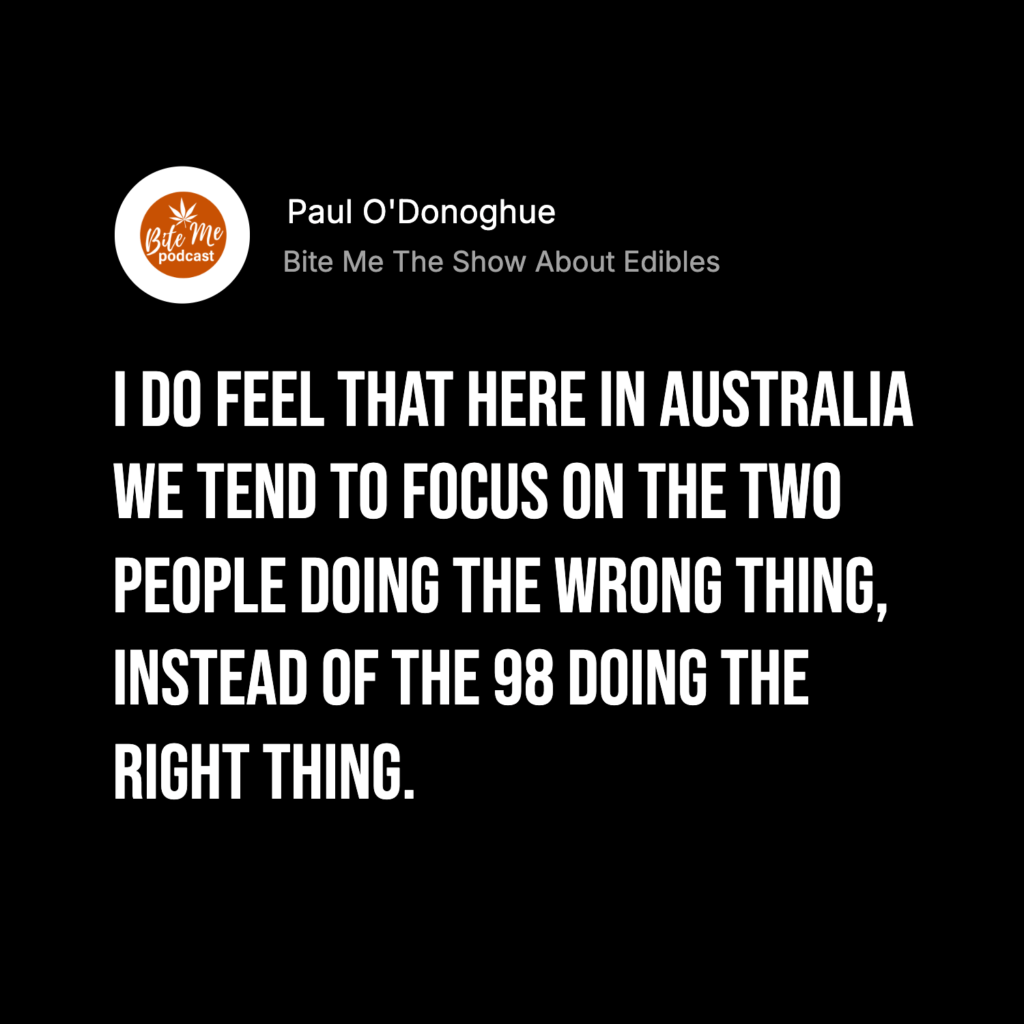
Paul O'Donohue 00:38:00 We just have this habit in Australia of focusing on the few bad actors. So the few bad doctors, the few patients that are, you know, we have a phrase here taking the piss. You know, who are who are who are not taking it seriously. And I actually have a moment in Canada that helps me understand the different disposition between Australians and Canadians. The liquor store that I worked at had 100% customer satisfaction policy. Meaning if you bought a bottle of wine that you did not like, you could come back within 48 hours, 72 hours and say, hey, did that? You know, I drank three quarters of it. It sucks. I want something different. And I was I was absolutely appalled. And I asked my manager, I'm like, don't people take advantage of that? And he was like, yeah, maybe 1 or 2 people have. But, you know, ultimately most people do the right thing and that's worth us investing in. And I went, yeah, you know, if 98 people are happy and a two people are taking us for a ride.
Paul O'Donohue 00:38:52 Let's focus on the 98. I do feel that here in Australia we tend to focus on the two. We tend to focus on the people that are doing the wrong thing. There are so many people here benefiting from access to medicinal cannabis, even if it's just stopping them from accessing a dealer, even if it's just stopping them from going to that shitty guy. You know, a couple of suburbs away who's overcharging you for cannabis. Chock full of plant growth regulators. it's actually it's a shame that we're demonizing the people who are getting out of the black market as much as we are here in Australia, and there are some great pharmacists and doctors who understand that, that that's harm reduction. But I'd say the loudest voices in some of the governing bodies are seeing that as a problem. You know, that people might be not going to a dealer anymore, because there's that kind of old prohibition thinking, whereas if if we restrict access, people will just stop using it. You know, that's it. Right.
Paul O'Donohue 00:39:48 But we know that's BS.
Margaret 00:39:49 Well know that that has never worked anywhere. No world.
Paul O'Donohue 00:39:53 We see it in Australia. Literally right now we have a thriving $3.5 billion illicit tobacco market selling vapes and nicotine because our government over the last 20 years has just continued to tax and overregulated cigarettes. Look, I hate cigarettes. I'm going to be straight up. They're disgusting. I don't want to sell them. I wish, I wish people I love didn't use them. However, from an adult point of view, if people are making a decision to use them, that is their prerogative. If it's in a safe environment, if it's in the home, I don't want to smell it on the street, but I'm not here to judge them for using it. But a packet of cigarettes? I couldn't even tell you how much it is these days, because I just know how high the tax is. Pouches of tobacco vapes were made illegal last year. Did people stop using vapes? No, they just started going to, you know, these American confectionary stores just started popping up everywhere that salivate.
Paul O'Donohue 00:40:43 And they're now just twice as much as they used to be for the same thing. And we're finding, you know, highly illegal illicit markets and criminal activity. So that's kind of that feels like the Australian way sometimes, you know, we'll just cut it off. We're not supplying it. And now it's their problem and it just creates much bigger problems. So to sum up returning to Australia, it was bad quality weed, overpriced, chock full of plant growth regulators, which means you weren't even experiencing the therapeutic benefits of, you know, cannabinoids inside of trichomes. You're just basically huffing glue. And that was really sad that that was really, really sad. You know, $300 for an ounce of garbage that's harmful. And so in 2022, I was able to go through the medicinal process after, you know, a year and a half of disappointment with Australian cannabis. I have an amazing clinic in a company called Astrid. and, you know, they I've been with them for the last three and a half years now as as my doctors, as my care team.
Paul O'Donohue 00:41:43 And that has allowed me to explore different products that work for different times of day, different ailments. You know, it is really refined. You know what is medicinal? What is therapeutic? I'm not there being like, oh, that was really fun. So, you know, give me a few more scripts for that. I do have to be mindful of that language, even if something is very fun. but as much as I adored my time in Canada and having fun with cannabis, coming home and refining my regime down to about, I think I have about 4 or 5 products at any given time. you know, with multiple scripts that can last for about 4 to 6 months. It's been really amazing to think, how is this cannabis working for me? How is it making my life better?
Margaret 00:42:22 Right. So it sounds like it's almost making it a lot more intentional than just buying willy nilly, I guess. Yeah.
Paul O'Donohue 00:42:27 It is. And I thought about a lot about that as I listened to your recent episode with Amanda Reiman.
Paul O'Donohue 00:42:32 Like, you do need to be mindful of your consumption. She spoke about how even as you age, you change. Like I was in when I was in Canada, I was 30 and my like, I could smoke anything. Like honestly, just anything like as much as I wanted for as long as I wanted. I'm 36 now, you know, I'm getting older and I'm noticing a change in my tolerance, a change in my ability to process and a change in what I need. so that's been really nice to think about that and be accountable with a doctor that cares about you. You know, I keep a pretty nerdy Google doc that where I review everything that I've had and everything and how it affects me. every kind of 4 to 6 months when I have that doctor's appointment, it's a 20 minute appointment. it's really nice to just kind of check in and be truthful. Oh, that thing just got me really high. That actually didn't improve my life or restore homeostasis in any particular way.
Paul O'Donohue 00:43:26 So thank you for letting me try it. Not for me. You know, I think that's really profound. because I no longer have those moments where I used to kind of go downstairs from my apartment in Vancouver, have a joint come back up my wife and be like, how is that? I go, yeah, just give me 40 minutes. That that was that that wasn't a good one. So, you know, there is there is bad moments there and much more few and far between. And I think it's important to acknowledge that even the most experienced consumers can still have, you know, adverse effects. You know, Amanda alluded to that as well. People don't often want to talk about that. it's not great being high all the time. It's not great. You know, being brain dead. I you know, I want to emphasize those things as much as I'm a functional stoner, if you will. You do have to check yourself.
Margaret 00:44:07 Yeah, for sure. And it's funny that you bring up Amanda Because I have also definitely found that my tolerance has changed as I've gotten older and I embrace it now.
Margaret 00:44:15 I figure it's just the season of life that I'm in, and it'll probably continue to happen until the day that I'm no longer on this earth. So having a medical system in Australia that takes that sort of relationship between yourself and the doctor and how you're consuming cannabis, I think sounds actually really special because we don't really have that here anymore. And I wasn't a medical user before it legalized here, but I don't know anybody that had that kind of patient doctor relationship that they could talk about cannabis like that here in Canada. So like what are your thoughts on I guess Australia seems to be taking a much more cautious and medical focused approach to cannabis reform compared to Canada that just, like, ripped the Band-Aid off and legalized. What's your thoughts on that pace? And do you think that Australia is being more prudent by by approaching it that way?
Paul O'Donohue 00:45:05 Yeah, I'm incredibly proud of the medicinal system we have here. I think it's unlike any other in the world, and I think there's an air of legitimacy to it that needs to be celebrated and maintained.
Paul O'Donohue 00:45:16 At the same time, it has been squeezed into a box that doesn't make sense. You know, it is not your typical therapeutic product. It is certainly not your typical medicinal product. And so even, you know, I'll talk to doctors and pharmacists and there's this desire for long longitudinal studies in the effects of flower. And we all know that despite, you know, the best GMP facility creating consistent cannabis, there is still going to be a difference in expression from batch to batch. You know, a company will send me their COAs for flower with the terpene profiles that are that are listed, we'll create marketing materials for those products and then boom, the next batch comes and little has slipped down and human genes slipped up. And you know, there's alpha pining and beta pining instead. And I think that's really evident. And it really demonstrates just how we can't expect this to be a typical pharmaceutical product, right? On the other hand, as well, you know, products like sativa that have been created by the pharmaceutical industry are not successful products because that's not how people want to consume cannabis.
Paul O'Donohue 00:46:20 So I love our medicinal system. I will constantly fight for it. I hope that as we move towards adult use reform, decriminalization, that we fiercely protect it. But I do want a little bit more understanding of cannabis being a different substance to your typical pharmaceutical driving. Some of the decision making. You know, again, there's decision makers here that don't fully understand what they've got. They want it to fit the boxes that they're used to. You know, pharmacists are dispensing it. So, you know, even when it comes to product substitutions, you know, my state of Victoria is really good. You know, if I've got a script for an indica 2,025% THC indica, well, then, if that's out of stock, I can get any other 25% THC indica. Other states are not like that. And so it's really difficult to be a patient. Really difficult to be a consumer across Australia because of the competing rules, but also the competing ideologies. You know, I sat with Dan Hara just the other night at dinner, son of, you know, infamous or, you know, famous cannabis advocate Jack Hara.
Paul O'Donohue 00:47:26 And he's there talking about, you know, the importance of terpenes and the importance of patients having a relationship with the plant. And a pharmacist from Australia just goes to make people don't care about strains and terpenes. And I'm like, they, they do. They absolutely do. And it's pretty bold of you to tell. You know, one of the most important people in cannabis that all Australians don't care about it. So, you know, no disrespect to that person because they're speaking from their experience with the patients that come to them, and they may have patients that do just want, you know, best bang for their buck. And I still respect those people and the people managing them. But I think it's really important that we don't lose sight that this is way bigger than any one of us. Way bigger than any system. And as much as I love our our medicinal legitimacy, it is being kept in a way that, you know, cannabis used to be kept by some of the OGs. So it's like pharmacists and doctors who have only just become the stewards of this product and now making decisions that, you know, I don't necessarily always agree with and, and have these fierce opinions and fierce desires for our framework, even to pull things back into scale it back.
Paul O'Donohue 00:48:30 But I think just sometimes forget that, cannabis is bigger than you are. It's bigger than any one person.
Margaret 00:48:36 Yeah. And I guess what, it's in the medical system like that, too. It just means like, they're like. And like. You already touched on the fact that harvest, a harvest, a cannabis plant can be very different and also person to person. So I consume something and I'll get a very different effect than you might. And these doctors and pharmacists aren't coming from that world. They're coming from a world of standardization. And they want everything to be the exact same, so they can better inform their patients, I guess. But that is maybe the drawback to cannabis in a medical setting, but also its potential power too, because there's so much to explore. But it's never going to fit very neatly into that box that they want.
Paul O'Donohue 00:49:14 Yeah, that's exactly right. It is about it not fitting neatly into boxes. And we have our Australian Medical Association and Pharmacy Guild of Australia right now actively trying to discredit the benefits of medicinal cannabis, actively trying to get, you know, they are lobbying our, our health Minister, Mark Butler, to restrict access on an extreme level.
Paul O'Donohue 00:49:37 And it's really unfortunate because not only are they trying to do that, they're refusing to engage with the industry. So we we have our own, you know, peak bodies within the industry that are more than willing, that have legitimate people, that have the doctors that have the researchers to share the information. And they're not only, you know, espousing really bad ideas and really horrible negative, unscientific ideas. we you it kind of plays in again to that like horror that I have about sometimes people you have more in common with are fighting against you. And it is just concerning to know that some of our peak bodies are so against it. But, you know, I'm sure that could be its own podcast in the theories of why, you know, medical authorities are against cannabis. You know, we can talk about the bottom line. We can talk about, addiction to opiates and things like that. But obviously, you know, that's a topic for another time.
Margaret 00:50:30 That is a whole other episode for sure.
Paul O'Donohue 00:50:33 Yeah.
Margaret 00:50:34 I'm looking at the Australian landscape right now with the growing patient numbers and emerging domestic brands and of course, ongoing legal debates. What excites you most about the future of cannabis in Australia?
Paul O'Donohue 00:50:46 Yeah, look, I'm excited to see patients not being discriminated against. And honestly, I'm sorry that that's not a there's not a more glamorous desire. I think it's kind of testament to where our market is. It is a very early juvenile market. There's a lot of cannabis naive people. And interestingly, our patient numbers aren't going up. So we've actually plateaued at around 3% of the population. And a huge amount of people are really scared of those driving laws that I mentioned earlier. You know, it's basically part of your consult, you know, if your doctor hasn't told you that every time you get in your car, you're at risk of losing your license. They kind of haven't done their due diligence. And I know that that is stopping people from accessing medicinal cannabis. So long story short, in Australia, you can be pulled over for a roadside drug test at the discretion of the police.
Paul O'Donohue 00:51:34 You don't get to consent to that. It's just done. THC is measured in presence. Therefore, if the presence of THC in your system, therefore you lose your licence. in Victoria, our legalised cannabis party recently fought for a change that came in in March, where you now have a legal defence as a medicinal cannabis patient. So you still have to go to court. And this is what we're fighting for. We're fighting to eliminate the court part. You still have to go to court, present your case, and it's up to the police to prove your impairment. Chances are they're not going to be able to do that. So if you have, you know, if you weren't impaired but just came, had the presence, you're probably going to get off. And speaking to lawyers since March, every person that has has presented themselves properly in court has gotten away with it. You know, unfortunately, there are there are still a few people that are fiercely, you know, whether it's sovereign citizens or, you know, anti-government stances will go into that courtroom and be difficult and horrible and still end up losing their license.
Paul O'Donohue 00:52:32 That's their prerogative. But ultimately, everyone who's gone in told their story respectfully, inappropriately, has gotten has been able to maintain their license. So not only do you not lose your license immediately, you get to go to court and maintain it. So that's a huge thing for Victorians that unfortunately, is not the case in any other state. Tasmania does have some protections, but you have to have a Tasmanian doctor and a Tasmanian dispensary and they are hard to find. So even Tasmanians are losing their licence because the Tasmanian doctor prescribed it. But then they got their cannabis from Victoria. So we still have these incredibly ridiculous, convoluted laws that have not kept up with the progress of society, the progress of our medicinal legitimacy. And so it's not very exciting. Margaret. I'm sorry. You know, I would love to be like, oh, I want nano emulsion beverages, and I want bath bombs, and I want CBD patches. There are things I do really want because I experience them in Canada, but I just so dearly want our patients to stop being discriminated against so more people can experience it.
Paul O'Donohue 00:53:34 More people can get the benefit of cannabis in their life. You know, I know so many people who would much rather knock off work with a gummy than, you know, a bottle of wine and they're still sticking with that bottle of wine because they know that, you know, there's X amount of hours you can wait and you're all clear on the roadside test. Whereas with cannabis, you know, like, I know for a fact, I would always have TFC in my system.
Margaret 00:53:55 Most of us would. Most of the people listening to this podcast will probably have some levels of THC in their systems. So yeah, that totally makes sense. And I wouldn't say that's not an exciting answer. I mean, you obviously want in Australia what perhaps we have on a certain level here in Canada is just the freedom to consume. And I would say from my personal experience, I don't think there have been more traffic fatalities, fatalities or anything like that due to cannabis legalization here than prior to. And how sad is it that people are opting for the alcohol versus the gummy because they're worried about those pretty big effects on their life if they were to get pulled over? when we know more and more that alcohol is carcinogenic and really not good for you.
Margaret 00:54:39 Like every time I seem to open up some news app or something, it's just like alcohol is going to kill you and yeah.
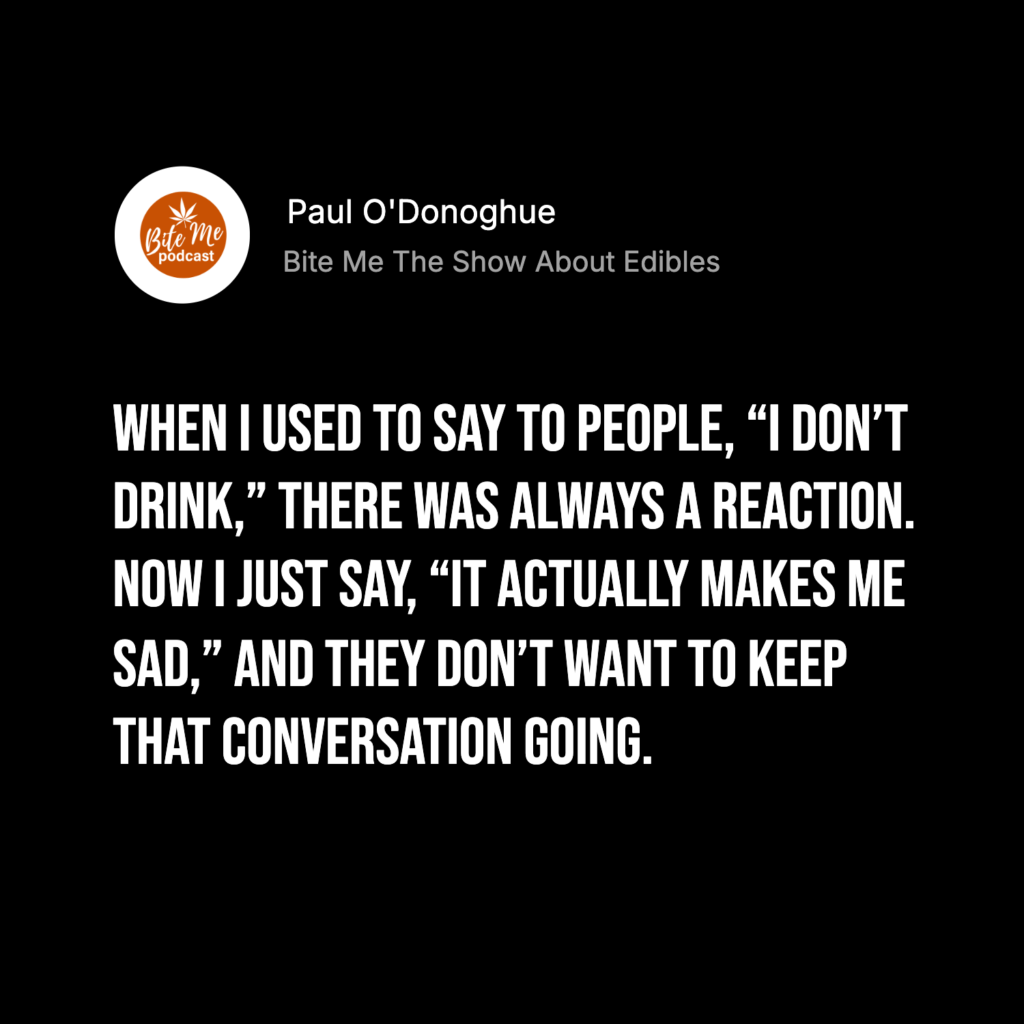
Paul O'Donohue 00:54:45 Yeah, look absolutely like you are literally poisoning yourself. And I'm not sitting here on my high horse saying people shouldn't do it, but, I've even found it effective because I pretty much don't drink alcohol anymore, you know. In Canada, I stopped drinking entirely because of nano emulsion beverages, you know? And then you do find, when you come back to Australian culture where there's less cannabis, you'll end up having a drink here or there. When I used to say to people, I don't drink or I don't really drink, there's this like, oh, what, what? You know, like, are you doing are you doing Dry July? Or you're raising money for a good cause? So I started saying to people, I go, oh yeah, I don't really drink and I'll go, why? I go, oh, it actually makes me sad. And they do not want to keep that conversation going after that because they after they'd have to talk.
Paul O'Donohue 00:55:28 Yeah. Well, they don't want to talk to me about my mental health or reflect on their own. So it's actually been hugely helpful for me to say that. And sometimes I'll be even like, do you ever find it makes you sad that, like, they do not want to touch that with a ten foot pole? So, that's been my survival strategy. I still do have the odd drink here and there. And, you know, even now being part of the industry, I cannot believe how much booze is, you know, at the event, you know, there'll be people that, oh, no, I don't touch cannabis, but they'll have no problem drinking 40 beers and making a fool of themselves. So, it's quite ironic, actually. Like I continue to see. yeah. The vino flowing. Unfortunately, not the, Not the herb.
Margaret 00:56:07 Yeah, yeah, it's, I'm going to have to use that line like, the whole. It makes me sad because I think that that's just so perfect.
Margaret 00:56:14 And it is interesting because here in Canada too, like, I'm going to be heading out in a, in a few hours to meet some friends, and I don't drink very much, but sometimes I go out and I have a drink because there is no other option. Like I could sneak in a cannabis beverage and I have done that in certain places where, you know, I can kind of get away with it, but a lot of times you can't, and it's my only option. So I might have a drink or whatever, but I would rather be able to have a cannabis beverage instead every day.
Paul O'Donohue 00:56:41 That's that's such a great way to put it. It's, it's it's my only option. Like, you know, I want I want a little something to to socially lubricate. I'm going to have to go with with a drink tonight. Yeah.
Margaret 00:56:52 Yeah. It's either the drink or nothing at all. I've done both. but. Or sometimes, like I said, I have snuck in things here and there, but they tend not to be at bars but other types of events.
Margaret 00:57:00 But don't tell anyone.
Paul O'Donohue 00:57:02 So yeah. Yeah, well, I think that reminds me a little bit of that kind of BC liberalism, which I was really proud of. I also remember and it took me a while to get used to, but I dine out with someone, you know, whether it was a rep from a cannabis company or, you know, just a friend, and you'd tell the server you're like, oh, can you just hold our table for ten minutes? We're just going out for a joint. And just those little things, you know? And so I do remember one place that was near my work, they were like, oh, do you need a rolling tray? And I'm like, oh, I'm in heaven here. So, you know, there's like I said, you know, there was a lot of pinching moments in Canada. Just those little things went a long way for me as an outsider.
Margaret 00:57:38 Yeah, yeah. It's true. I mean, if you go any place where they do serve alcohol, you'll always see somebody outside smoking a joint.
Margaret 00:57:45 That's. And you can like, you don't have to worry about somebody saying, hey, what are you doing? Which is really nice because you just you just don't have that concern. You're not looking over your shoulder anymore. And I really hope that that comes for you in Australia very soon. Now, Paul, I want to be mindful of your time. But as we wrap up today, can you talk a little bit about what's next for you and give and talk?
Paul O'Donohue 00:58:06 Absolutely. So like I said at the start, giving talks have always been about adding value, you know. it is it's a podcast. It's an Instagram page. It's also a line of merch and accessories. You know, there there is a commercial element there. But I think it's important that people know that giving talk doesn't exist. You know, through a love of e-commerce and merchandising, it's actually, again, about adding value. So, you know, the the merch we have is small proof bags, rolling trays with lids.
Paul O'Donohue 00:58:34 These are things that I use myself. You know, they were inspired by my time in Canada. Good accessories can again help destigmatize. So I'm really proud of the small line of products we've got. You know, I don't just sell them because I like sales. I sell them because I know that they bring value to people's homes. Like, I'm a big camper. So, you know, a lockable, smell proof bag when you're travelling in the hot Australian summer to go camping is really helpful. And pray with a lid on it. You know that's falling off your lap from a camp chair is is invaluable. So I use these things myself. That's why I sell them. Not because I'm trying to make money. so I'm really proud of that. And I've got to shout out my wife, Ruth, who kind of came on, joined forces with me with give and took to make it beyond just a podcast to help bring that to life. So a big shout out to Ruth there. So the range of accessories will continue to grow as I find more useful and meaningful and purposeful things.
Paul O'Donohue 00:59:27 You know, people keep asking me for a grinder. There are so many great grinders out there that I'm not just going to make one just for the sake of it. So, you know, share that to all the other great creators and businesses that are making products that are really useful. so we'll see more products coming over the next year, more physical presence. So one of the great things about the products is the desire to have them on shelves like I don't, you know, desperately reach out to pharmacies and dispensaries saying please stop my product. I let them come to me because I know that there's a partnership desired. They're like, I want to work with companies and stores and dispensaries that have a real vision about patient care, so that part of the business side is going to grow. When it comes to the podcast, I'm really excited to have some pretty big international guests in the pipeline for 2026. So we'll continue to kind of expand the reach of the show, you know, is for Australian audiences.
Paul O'Donohue 01:00:16 However, you know, we're seeing more, external forces coming to Australia and having impact. you know, like Jack Herer brands. We're about to see cookies. California genetics come to Australia through its own brand. you know, shipping skis will be here as well. So it's really cool to see some of those big players coming to Australia. Not just not just because, but because they, you know, they want to bring their great genetics and their experience to Australia. I recently released some great t shirts, which will probably be sold out by the time this episode goes to air. and yeah, just continuing to find ways to add value to people. I think it's been a real privilege to, to have some public role in the cannabis space in Australia, to have some influence over people. I don't take that for granted. And I always ask that, you know, listeners of the show, and particularly people that enjoy the show, offer any feedback. They've got to make it better because it is for the audience.
Paul O'Donohue 01:01:10 It's not for me. so yeah, some exciting things with the merch, exciting things with new podcast guests. I don't think anyone's ever going to see some outrageous growth of give and take. I think it's just a nice little passion project that pops along as I have my real job also. but I do think that, that I'm adding value to the community by, you know, bringing really reliable, interesting people onto the show. You know, that that means a lot to me, that there's, you know, I've never had a bad show. I've had a string of really fantastic guests. And look, just to, you know, be able to come on this show today and share my story has been a real privilege as well. So anyone who's intrigued about give and take, anyone who's intrigued about what's happening in Australia. Check out Cosmo. see what we're doing down here. See what we're fighting for. it's it's a labor of love. It is a drag sometimes, but ultimately, it's a real privilege.
Margaret 01:02:03 Yeah. That's amazing. And a big shout out to Ruth. It sounds like you two are a real dynamic duo. And I will be watching to see what you come up with for 2026, because I do. I've listened to your show and I enjoy it. So I think you're doing a wonderful job, and as a podcaster, I know how tough it can be. So keep up the great work and thanks for sharing your time with me today.
Paul O'Donohue 01:02:23 Very much appreciate it. I'm so grateful for the opportunity to share my story. I'm a big fan of your show. I love the work that you're doing, and I think it's really nice to find, you know, across the pond or whatever the expression is. These like minded people, you know, you and I have lived in the same country on opposite coasts. We now live in different countries, and here we are sharing something special today. So I hope I'm not putting you on the spot by saying, I'd love to have you on my show so we can flip the mic a little bit, and we can narrow that about podcasting a bit.
Paul O'Donohue 01:02:52 And, you know, you can share similar things about your journey, because I think we absorb a lot with the people that we listen to. And I never want to be the star of the show. I never want to be the loudest voice in the room. But I always appreciate the opportunity to to sometimes just reflect.
Margaret 01:03:08 Yeah, I would love that, I appreciate that. Yeah, it's a yes.
Paul O'Donohue 01:03:12 Excellent, excellent. Well, we'll work that out behind the scenes and I'll really look forward to. Yeah. Flipping this back on you.
Margaret 01:03:18 Yeah. All right. Thank you.
Margaret 01:03:20 I hope you enjoyed this conversation with Paul as much as I did. Paul is a great guest. And as always, you will find all the detailed show notes online. So if you didn't have a pen to jot anything down, don't worry. I've got you. And I invite you to continue the conversation over at the Bite Me Cannabis Club. It's algorithm free and if you enjoyed this conversation, why not share it with a friend? Until next time, my friends.
Margaret 01:03:43 I am your host, Margaret. Stay curious and stay high.
Sign up to receive email updates
Enter your name and email address below and I'll send you periodic updates about the podcast.
Q&A: Navigating Cannabis Culture, Policy & Community with Paul O’Donoghue
Q1: What inspired Paul O’Donoghue to start the Give and Toke podcast?
Paul started Give and Toke after returning to Australia from Canada, where he had worked in a legal dispensary. He noticed a huge gap in cannabis education and storytelling in Australia. The podcast began as a way to share Canadian cannabis experiences and later evolved into a platform for discussing policy, medical use, and culture in Australia.
Q2: How does cannabis culture in Canada differ from Australia?
In Canada, cannabis is federally legal, widely accessible, and sold in regulated retail environments. In Australia, cannabis is only legal for medical use under strict regulations, and recreational use remains prohibited. Cultural attitudes in Australia are more conservative, and stigma is still prevalent, especially around roadside testing and public consumption.
Q3: What was Paul’s experience like working in a Canadian dispensary after legalization?
Paul described it as a “pinch me” moment. He was among the first Australians licensed to sell cannabis in Canada. However, he noted that early legal products were often overpriced and low quality compared to legacy market offerings. Over time, the market improved, but the transition was rocky for many local consumers.
Q4: What does Paul think about the tension between corporate cannabis and craft growers?
Paul believes both have a role to play. Corporate cannabis brings investment and legitimacy, while craft growers drive innovation and quality. He advocates for mutual respect and regulatory frameworks that allow small-scale producers to thrive without being squeezed out by big companies.
Q5: How does Australia’s medical cannabis system work?
Australia has a medically focused system where patients must get a prescription from an authorized doctor. Products are dispensed through pharmacies, but regulations vary by state. Paul appreciates the legitimacy of the system but criticizes its rigidity and the lack of understanding among some healthcare providers about cannabis as a plant-based medicine.
Q6: What is the biggest challenge facing Australian cannabis patients?
Roadside drug testing. Australia tests for the presence of THC—not impairment—which means medical patients can lose their licenses even if they’re not high. Paul and other advocates are pushing for legal defenses and science-based impairment testing.
Q7: How has Paul’s personal cannabis use evolved over time?
Paul started using cannabis as a teenager and viewed it as a social alternative to alcohol. After moving to Canada and later returning to Australia, his use became more intentional and medicinal. He now tracks his consumption and works with a doctor to tailor products to his needs.
Q8: What advice does Paul have for new cannabis consumers?
Start low and go slow. Be intentional about what you’re using cannabis for—whether it’s relaxation, pain relief, or creativity. Keep notes on what works and what doesn’t, and don’t be afraid to adjust your approach as you learn.
Q9: What’s next for Give and Toke?
Paul plans to expand the podcast with more international guests in 2026 and grow his line of practical cannabis accessories. He remains focused on adding value to the community through education, storytelling, and advocacy.
Q10: What can listeners do to support sensible cannabis reform?
Stay informed, vote, and contact local representatives. Support craft growers and ethical brands. Share your positive experiences with cannabis to help reduce stigma. And most importantly, listen to and learn from diverse voices in the cannabis community.
[…] Inside Australia’s Cannabis Shift with Paul O’Donoghue […]